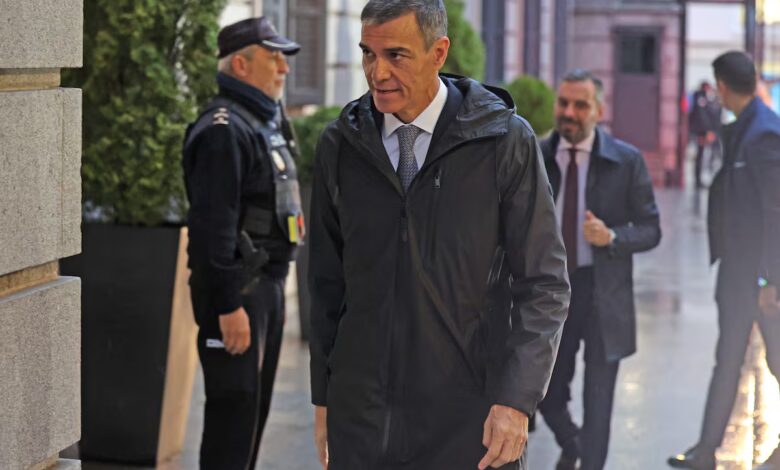
A year ago, the Socialists concluded their national congress in Seville, where Pedro Sánchez was once again elected party leader and sought to rally his colleagues amid challenging legal battles. Today, the situation in the PSOE has become even more fraught. Key figures such as Santos Cerdán and José Luis Ábalos are now under investigation in corruption cases. Adding to this is a high-profile case involving Paco Salazar, who faces charges of sexual harassment and abuse of power.
Within the party, there’s increasing talk of ‘internal cannibalism’—a struggle for control over the PSOE in the event of Sánchez’s departure. Many believe that the current scandals are being leveraged to redistribute influence and prepare for a potential leadership change. Party veterans and regional leaders note that tensions are rising, and some are already openly discussing possible scenarios for the post-Sánchez era.
A struggle for influence
Supporters and opponents of Sánchez within the party are engaged in a covert battle, including using high-profile cases against former allies. The name Adriana Lastra, the former deputy secretary general, has resurfaced in these discussions—she has become one of the most vocal figures in the Salazar case. Lastra, who once supported Sánchez, now serves as the government delegate in Asturias and is emphasizing her stance as a feminist leader amid the scandals shaking the party’s upper echelons.
Some party officials admit that internal jockeying has already begun within the PSOE. According to them, each new scandal becomes a trigger for infighting, and accusations against former leaders are being used to weaken Sánchez’s position and pave the way for a potential transfer of power.
Corruption and new accusations
In addition to ongoing investigations, new allegations of sexual harassment have surfaced. In particular, the mayor of Almussafes, Toni González, claimed he was the victim of revenge, but was forced to step down from party posts under pressure from regional leaders. Some fear that the party’s internal complaint system could be used for settling scores, which would only exacerbate internal conflicts.
The secretariat of one of the PSOE’s largest federations has expressed concerns that false accusations could seriously damage the party and benefit the far right. However, other leaders insist on the need to respond immediately to any violations to prevent similar incidents in the future.
Regional divisions
Despite growing internal tensions, most leaders deny the existence of an organized movement against Sánchez. Open opposition comes only from individual veterans and figures such as Emiliano García Page. In regions where Sánchez’s leadership had previously been questioned, personnel changes have taken place; now key federations — Andalucía, Valencia, Madrid, Aragón — are led by ministers who will soon face their own test at the polls.
In Andalucía, many expect a possible ‘eruption’ of internal disputes after the regional elections, the date of which has yet to be set. In Cantabria and Murcia, where recent primaries were fiercely contested, new outbreaks of infighting could occur if the election results prove disappointing. In Galicia, disappointing results have been compounded by a scandal involving harassment allegations against one of the leaders, José Tomé, who resigned from his leadership positions but remains mayor and deputy.
The post-Sánchez era
Many within the party believe the current situation was largely provoked by Sánchez himself, when in April 2024 he took a pause for reflection after a case was opened against his wife. At that point, many socialists began to consider the party’s future without its current leader. Although Sánchez later decided not to step down, the question of his successor remains unresolved.
In July last year, Sánchez admitted he had considered resigning after the UCO report on the Serdán case was published. He now regularly states his intention to run again, but within the party, there is ongoing talk about a possible repeat of the events of 2016, when the PSOE leadership joined forces to remove him in order to support Mariano Rajoy’s government. Some believe that a similar scenario could happen if the Socialists lose the election, although others are convinced that the current alliances with PP and Vox make this unlikely.