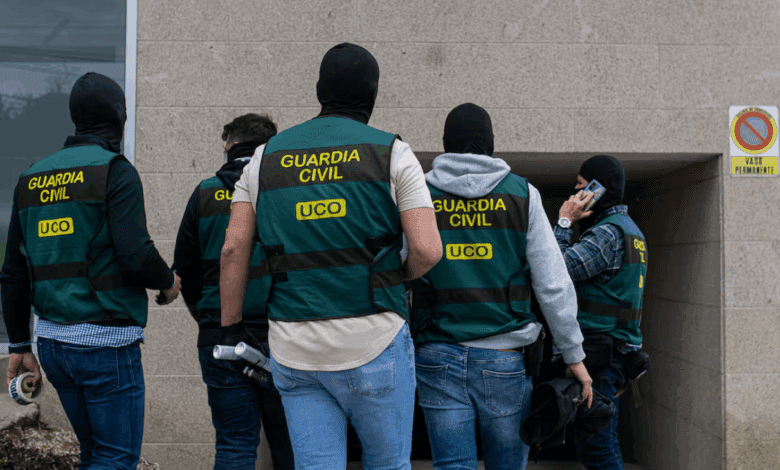
Significant personnel changes are expected soon within the structure of Spain’s Civil Guard. The country’s Council of Ministers plans to approve the promotion of Rafael Yuste, currently head of the Central Operative Unit (Unidad Central Operativa, UCO), to the rank of brigadier general. This decision will automatically trigger a leadership change in one of the country’s most influential anti-corruption departments.
In recent years, the UCO has found itself at the center of high-profile investigations involving corruption at the highest levels of power. Among them are the case of Begoña Gómez, wife of the current prime minister, as well as the so-called Koldo case, in which former Socialist government minister José Luis Ábalos remains in custody, and former PSOE leader Santos Cerdán is listed as a suspect. Additionally, the unit is investigating the so-called ‘mask case,’ which concerns potential corruption schemes within the administration of Almería province, governed by the Partido Popular (PP).
Key investigations
UCO officers have also worked on the case that led to charges against the prime minister’s brother, David Sánchez, as well as the investigation that resulted in the conviction of former Attorney General Álvaro García Ortiz. In the past, the unit has handled high-profile cases such as ‘Púnica,’ ‘Lezo,’ ‘Erial,’ and ‘Taula,’ which involved prominent figures from the People’s Party. Operations targeting former leaders of Convergència were carried out as part of the ‘Pretoria’ case, and the ERE investigation that shook the Andalusian Socialists also did not go unnoticed.
Within the Civil Guard, officials insist that the upcoming reshuffle is not an attempt to limit UCO’s independence, as opposition representatives claim. According to them, it’s a standard procedure related to annual rotations and promotions within command ranks. This time, the changes are due to the retirement of two brigade generals: Francisco Javier Sánchez Gil, who headed technical services, and Arturo Prieto Bozec, who was responsible for the units in the Comunidad Valenciana. Both have reached the maximum four-year term in the rank of brigade general, as required by law.
Appointment procedure
The opening of these positions triggered a competition for replacements, open to colonels who have completed a special training course required for promotion to general. Rafael Yuste ranked first in his class, significantly boosting his chances for advancement, though there was no absolute guarantee.
When positions become vacant, a competition is announced for officers who have completed the last two courses required for promotion to general. A collegial body evaluates candidates by awarding points and compiles a list, which is forwarded to the General Directorate of the Guardia Civil and then to the Minister of the Interior, Fernando Grande-Marlaska. The minister coordinates the selections with Defense Minister Margarita Robles.
The minister’s role
The Interior Minister is not required to approve candidates in the exact order proposed by the collegial body, but must justify any deviation from it. There have been cases in the past where the minister did not follow the prescribed ranking. For example, Colonel Diego Pérez de los Cobos, despite finishing first in his class, resigned in December 2024 after being passed over for promotion. He challenged the ministry’s decision twice, and in both cases the Supreme Court ruled in his favor and overturned the appointments. Ultimately, however, Pérez de los Cobos declined to enforce the court’s decisions.
Thus, Rafael Yuste’s promotion will lead to a change in leadership at the UCO, which could impact ongoing investigations. It is not yet known who will head the anti-corruption unit after Yuste’s departure.