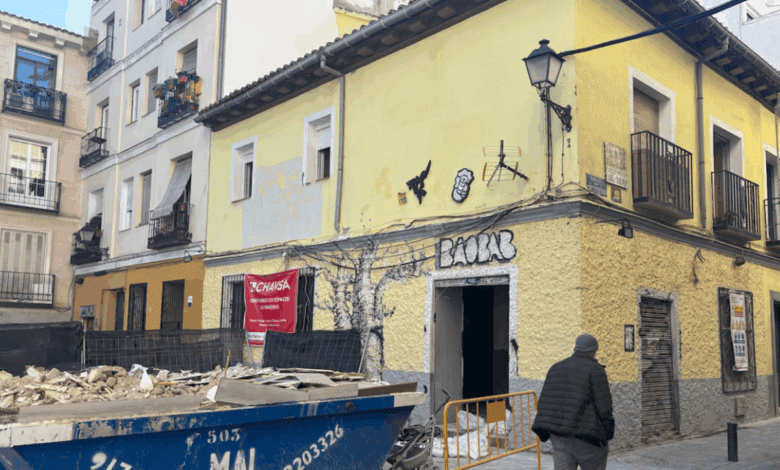
In the heart of Madrid’s Lavapiés district, demolition was abruptly halted for two historic buildings at Cabestreros Street, numbers 1 and 3. For many years, the Baobab restaurant operated here, becoming much more than just a venue for locals—it was a true symbol of the neighborhood. After twenty years in business, the restaurant closed its doors in 2020 when the building’s owner refused to renew the lease. The properties were purchased for 3.5 million euros by entrepreneur Javier González, who plans to replace them with a 288-bed capsule hostel managed by SmartRental, a company already known for its hotels on Gran Vía.
Demolition was scheduled to start in the coming days, but an intervention by city authorities changed the course of events. Madrid’s mayor, José Luis Martínez-Almeida, announced a temporary halt to the work. The reason: a complaint from the Socialist party, who turned to the prosecutor’s office over suspected crimes against the city’s cultural heritage. Although urban planning regulations do not grant the buildings official protection, the city council decided to wait for opinions from the regional government and heritage experts.
Arguments and protests
The complaint was initiated by the Socialists’ urban planning spokesperson, Antonio Giraldo. He argues that these buildings are not only important for residents but are also a rare example of 17th-century urban architecture. According to him, almost no such single-story houses remain in central Madrid, and their absence from the list of protected sites is a clear oversight. Giraldo notes that even if the buildings have long been abandoned, their historical value is indisputable.
Lavapiés residents are openly expressing their discontent. They believe the neighborhood is turning into a playground for tourists and investors, while real life disappears with places like Baobab. Posters featuring González’s portrait and slogans like “Enemy of Lavapiés. Speculators out of our neighborhoods” have appeared on the walls. People worry that demolition will trigger another wave of gentrification and drive out the last of the native residents.
Historical significance
The issue of protecting these houses is complicated by their location in Madrid’s historic center, designated as a Bien de Interés Cultural (BIC, Cultural Heritage Site) since 1995. However, the buildings themselves are not included in a separate registry of protected properties. According to Giraldo, this oversight can be corrected if the authorities want to at least preserve the ground floor or façade, since architectural solutions make it possible to blend the old with the new.
At the same time, representatives of other political groups, such as Más Madrid, criticize the city authorities for prioritizing the interests of the tourism business. They argue that permits for new hotel construction are granted far too easily, while the needs of local residents are ignored. As an example, they cite the neighboring building La Quimera, which has stood abandoned for 40 years, while another hotel project is planned for the Baobab site.
Battle for the Neighborhood
The situation around Baobab is not unique for Lavapiés. In recent years, the district has faced intense pressure from developers and the hotel industry. The company SmartRental, which is set to manage the future hostel, already owns several large hotels on Gran Vía and continues to aggressively expand its network. In addition to traditional hotels, they are opening aparthotels and colivings throughout the city, including Puerta del Sol, Atocha, Chueca, and La Latina.
Local activists recall a similar incident on Valencia Street, where residents were evicted and an Ibis hotel was built. Now they fear that the same scenario will repeat itself on Cabestreros. According to Manolo Osuna, head of the La Corrala de Lavapiés association, demolition has already started from the roof, and no one knows how badly the buildings are damaged. He warns that if it rains, the houses could be declared hazardous and demolished with little public discussion.
The Voice of the Streets
Osuna, who spent thirty years working as a postman in Lavapiés, recalls with nostalgia the days when Baobab was the heart of the neighborhood. According to him, the restaurant became one of the first Senegalese establishments in Madrid and quickly turned into a meeting place for everyone—from students to pensioners. Now, he believes, the area is losing its soul: “Before, I would walk into a bar and know almost everyone; now—barely ten percent.”
The future of the buildings on Cabestreros remains uncertain. If regional authorities do not recognize their historical value, demolition will continue. But even this temporary halt has already sparked a broad debate about what the center of Madrid should be—a place to live or just another tourist showcase. And while officials and investors argue, the residents of Lavapiés continue fighting for their neighborhood, unwilling to accept yet another loss.