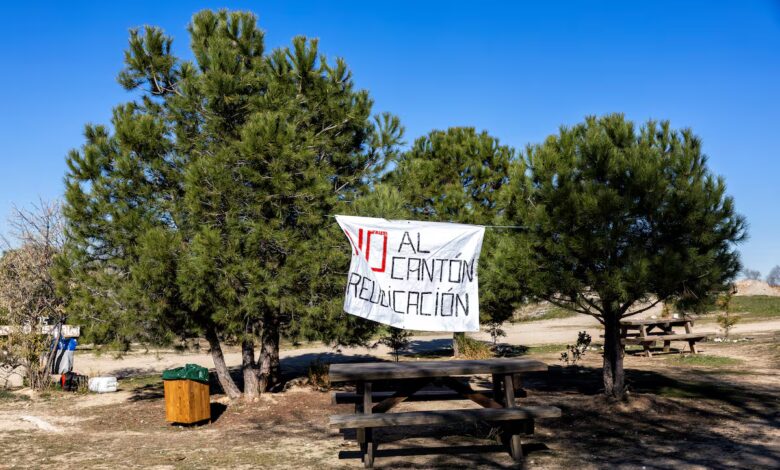
A conflict is brewing in the northern part of Madrid over the construction of a major facility for city services. The project in question is the so-called cleaning depot and emergency response base in the Montecarmelo neighborhood. What was initially described as a simple equipment parking lot and changing area for employees has unexpectedly become the center of legal disputes and widespread public discontent.
Last spring, the administrative court ruled against the city council. The judge noted that such infrastructure cannot be located among residential buildings and educational institutions. The main argument was the lack of a mandatory environmental assessment, which is required for facilities with industrial characteristics.
Internal contradictions
City officials insisted that this was not an industrial site, but merely an auxiliary space for storing equipment and staff. However, six months after the court ruling, the city hall released part of the project documentation, which explicitly states three times: the activities at the facility are classified as industrial.
This document, made available for public review, has put Mayor José Luis Martínez-Almeida’s team in a difficult position. The appeal to the court’s decision is currently being considered by Madrid’s highest judicial authority, but the city council’s own materials are undermining its previous stance.
Hazardous processes
The project documentation covers more than just parking vehicles. The site is also planned to include car repair workshops where flammable and toxic substances may be used. The text explicitly notes the risk of fire or explosion, as well as the handling of oils, solvents, and other polluting components.
Another issue is noise. According to calculations, if all sources operate simultaneously, noise levels could reach 106.5 decibels. For comparison, the maximum recorded at a concert in Madrid’s Santiago Bernabéu was 86 decibels. Since the decibel scale is nonlinear, a 20-decibel difference means more than a hundredfold increase in noise intensity.
Residents’ discontent
The city council’s calculations do not account for noise from outdoor trash compactors or from the movement of 117 vehicles coming and going around the clock. However, the explanatory note states that sustained high noise levels are not expected, and no activities causing strong vibrations are planned.
Despite this, the project has drawn strong opposition from local residents. According to a survey, more than 94% of Montecarmelo residents consider the chosen location extremely unsuitable. Opposition comes not only from residents, but also from all opposition parties and neighboring associations.
Alternative proposals
Activists claim that the city mayor and his deputy for urban development and environment, Borja Carabante (Partido Popular), have concealed the industrial nature of the site for over two years. They refer to the future site as a ‘megacantón,’ emphasizing that it covers more than 10,000 square meters and is located between residential buildings and three schools.
Residents and their political allies — Más Madrid, PSOE, and Vox — are offering an alternative: the ED1 lot in the Las Tablas industrial area, which has already received local residents’ approval. However, the city hall continues to insist on implementing the controversial project specifically in Montecarmelo.