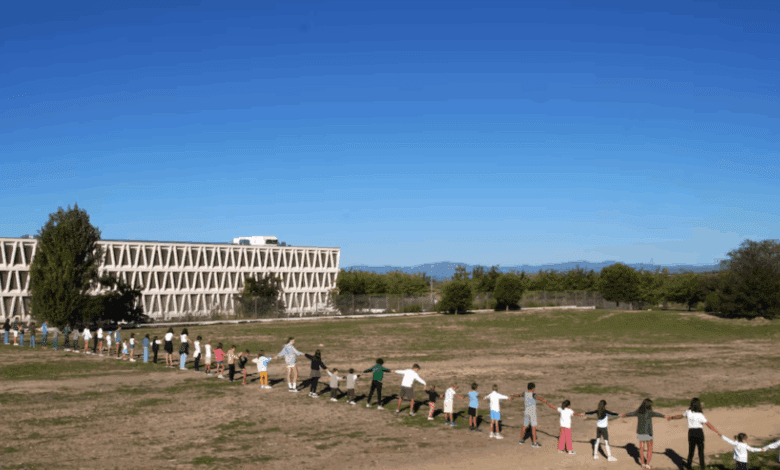
A conflict is unfolding in Madrid over a new public utility facility that city authorities plan to build in the residential neighborhood of Montecarmelo. Parents and residents are concerned that a large base for cleaning equipment will be located just steps away from schools and kindergartens. This decision has already escalated to the European Parliament, and the consequences could affect not only the capital but also other Spanish cities where similar projects are being implemented without taking into account the opinions of local residents.
The crux of the issue lies in the city hall’s plans to build an industrial facility covering 10,000 square meters, which many parents say poses a risk to the health and safety of more than 4,000 children. Work is already underway in the area: heavy machinery has cleared part of the forest, and noise and dirt have become routine for residents. Parent committees claim that city officials ignored a court ruling that declared the project invalid and continue construction in spite of protests and the lack of a proper environmental assessment.
Reaction in Brussels
A delegation of parents and activists traveled to Brussels to draw the attention of European deputies. They presented documents, photographs, and plans proving that the facility is actually an industrial base and not just a city cleaning station. Their arguments included internal city hall documents acknowledging that such sites should not be located near residential buildings and schools in order to avoid inconveniencing residents.
The European Parliament supported the parents’ initiative and launched an official investigation. Now it remains to be seen whether the project violates EU standards for child and environmental protection. The main concerns involve non-compliance with noise level and air quality standards, as well as the authorities’ failure to conduct the required environmental impact assessment.
Authorities’ stance
Madrid Mayor José Luis Martínez Almeida stated that he respects the residents’ right to appeal to European bodies but insists that the facility will not be a waste processing plant and will not result in constant truck traffic. According to him, the project aims to improve working conditions for municipal employees rather than worsen life in the neighborhood.
Nevertheless, parents and activists believe that authorities are acting outside the law, taking advantage of the fact that the court’s decision to suspend construction has not yet come into effect. They note that the city began work immediately after learning of the court order, without waiting for the completion of all legal procedures. This sparked a wave of outrage and new accusations against the city hall of using a ‘scorched earth’ tactic.
Next steps
Parents and residents of Montecarmelo do not intend to back down. A mass protest has already been scheduled at the construction site. They demand that the authorities reconsider the location of the facility and hold proper public hearings. According to their estimates, thousands of children will pass by the future base every day, and dozens of heavy vehicles will be driving through the area.
Attempts to secure intervention from regional authorities have so far been unsuccessful. Parent associations have appealed to the Madrid Department of Education but have not received a response. Meanwhile, according to El Pais, the city continues construction despite protests and ongoing legal disputes.
In recent years, Spain has seen a growing number of conflicts between residents and municipalities over the placement of industrial and public infrastructure near residential neighborhoods. Similar projects in Valencia and Barcelona have sparked mass protests and, in some cases, led to plans being revised or facilities being relocated. European bodies are increasingly stepping in to resolve such disputes, especially when there are concerns about children’s rights or environmental standards. The decision in the Montecarmelo case could set a precedent for other cities in the country.