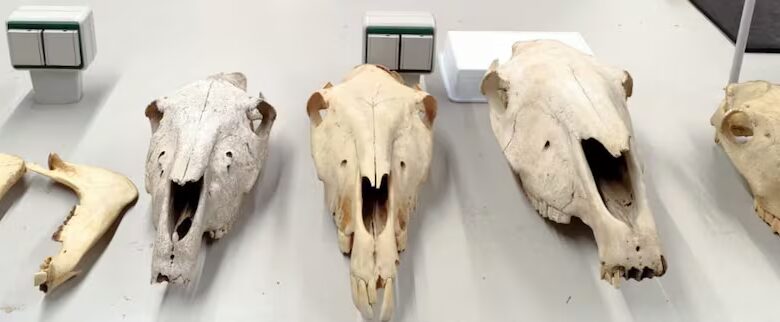
In the Catalan settlement of Castellví de la Marca, archaeologists have made a sensational discovery: in one of the ancient granaries, converted into a burial site, they found an almost complete skeleton of a mule estimated to be around 2,800 years old. This find is the earliest of its kind known to date in Europe and the western Mediterranean. Until now, it was believed that such hybrids appeared in this region much later, during the era of Roman influence.
The skeleton, consisting of 712 bones, was discovered at the Hort d’en Grimau archaeological complex, located in the Penedès region near Barcelona. Experts estimate the animal lived at least eight years and was buried alongside the cremated remains of a young woman, as well as fragments of handmade pottery. This unusual burial ritual highlights the significance of the mule in ancient society.
Ancient hybrids
Mules — the offspring of a horse and a donkey — have accompanied humans for thousands of years. However, such early evidence of their presence on the Iberian Peninsula had not been found before. This new discovery suggests that the hybridization of domestic animals may have started here earlier than historians previously believed.
Scientists have dated the find to between the 8th and 6th centuries BC, a period when Phoenicians were actively settling on the Iberian Peninsula. According to researchers, it was likely the Phoenicians who introduced donkeys to the region, allowing locals to breed hybrid animals for the first time.
Archaeological details
The mule’s skeleton was discovered in a grain silo that was later repurposed as a tomb. Nearby, archaeologists found the charred bones of a young woman and handmade pottery. The composition of the burial suggests a special attitude toward the animal, possibly indicating a ritual significance.
Bone analysis showed the animal was used for transporting goods. Its jaws bore traces of harness wear, and the skeleton’s structure indicates the mule was heavily used for farm work. DNA and dietary studies suggest the mule was either bred locally or brought from other regions.
International collaboration
Experts from the universities of Barcelona, Toulouse, La Coruña, and Extremadura took part in the study. Their combined efforts helped not only to precisely date the find but also to uncover details about the mule’s life and use in ancient times.
The skeleton is now housed at the Museum of Wine Cultures of Catalonia (Vinseum), where it is accessible to the public. The discovery has already sparked interest among historians and archaeozoologists, as it challenges previous ideas about the spread of domestic animals and ancient trade networks.
The Phoenician connection
The emergence of mules on the Iberian Peninsula is linked to Phoenician trade routes, as these peoples actively explored the western Mediterranean. They not only brought new goods but also facilitated the exchange of knowledge and technologies, including animal breeding methods.
The discovery in Castellet de la Marca confirms that hybrid animals were an important part of the economy and may have played a role in religious or funerary rituals. Mules were known for their endurance and ability to work in arid conditions, making them indispensable to the ancient inhabitants of the region.