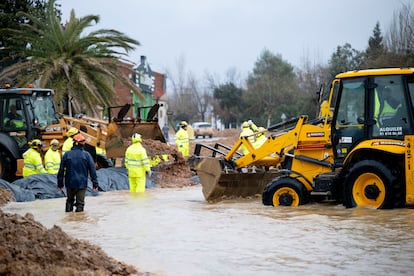
The powerful storm Oriana put many regions of Spain to the test, causing abrupt changes in weather and serious damage to infrastructure. Within a single day, residents faced flooding, snowfall, and gale-force winds, resulting in travel disruptions and property damage. Emergency services had to respond swiftly to numerous incidents in order to minimize losses and keep people safe.
In El Robledo (Ciudad Real), public works crews and firefighters worked around the clock, pumping water out of flooded streets and homes. Locals reported that water levels rose so quickly that many were caught unprepared for the impact. In Soria, the situation worsened when the Tera and Duero rivers overflowed, forcing the closure of the road to Tardesillas near Garray. Drivers had to search for alternative routes, leaving traffic paralyzed for several hours.
In Sevilla, on San Jacinto street, rescue teams dealt with the aftermath of a large tree falling across the road and damaging parked cars. In L’Hospitalet de Llobregat (Barcelona), strong winds hit an auto dealership, tearing off part of the roof and shattering display windows. In central Barcelona, gusts of wind knocked down a metal fence, temporarily restricting pedestrian and vehicle movement in the affected area.
In Zaragoza, residents witnessed a rapid rise in the water level of the Ebro River, raising concerns about possible flooding in the city’s low-lying areas. Local authorities urged citizens to exercise caution and avoid walking along the riverbanks. Overall, the impact of storm Oriana affected dozens of localities, and restoration efforts are still ongoing.
Emergency measures
Civil protection services and fire brigades were mobilized urgently. In some areas, residents had to be evacuated from homes that were threatened by flooding. Drivers stranded on flooded roads received assistance from rescuers, while municipal services worked to clear debris and restore traffic. Authorities warn of possible further complications as forecasts indicate unstable weather will persist over the coming days.
Reflecting on recent events, it should be noted that such weather disasters are no longer uncommon for Spain. For example, mass evacuations and road closures due to storm Leonardo in Andalusia also led to serious disruptions in transport and emergency services. With each new storm, it is becoming increasingly clear that the infrastructure needs additional protection and modernization.
Impact on the regions
The aftermath of the storm varied across the country. In the central and northern provinces, heavy snowfall disrupted road traffic, forcing municipal services to clear highways around the clock. In coastal areas, the main impact came from strong winds that toppled trees and tore roofs off houses. Some communities experienced power outages due to damage to transmission lines.
Local authorities have already begun assessing the damage and plan to allocate additional funds to restore infrastructure. Residents of the affected regions express concern about the possibility of similar incidents in the future, especially given climate change and the increasing frequency of extreme weather events.
Context and experience
In recent years, Spain has faced destructive storms and floods with increasing frequency. Disasters like Oriana cause not only property damage but also severe disruptions to daily life. Recalling the aftermath of storm Gloria in 2020, when roads were destroyed and entire neighborhoods flooded, it is clear the problem requires a comprehensive approach. Authorities and experts are discussing the need to invest in early warning systems and the reinforcement of levees to reduce risks for the population and the economy.