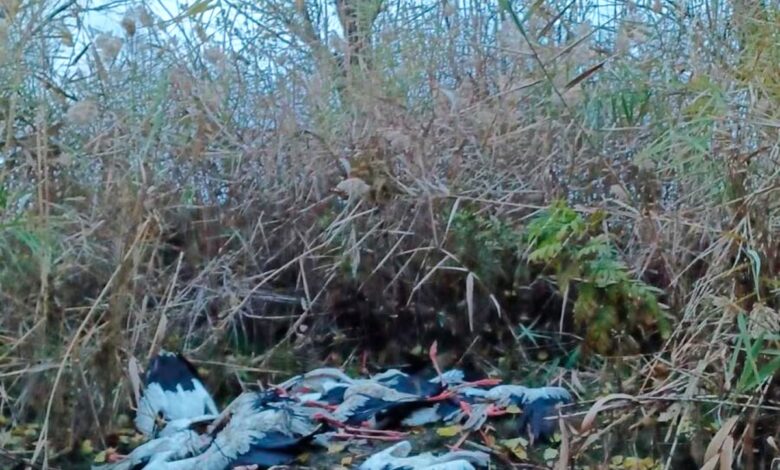
In the suburbs of Madrid, in the areas of Perales del Río and La Marañosa, hundreds of dead storks have been found over the past three days. Local residents and emergency crews reported seeing numerous dead birds floating in the waters of the Manzanares River. The scale of the incident has alarmed both experts and the public, as nothing like this has happened in the region for many years.
Forest rangers and emergency services immediately began collecting and disposing of the birds’ bodies. Special black bags were used for the process, and the remains were sent for incineration. This measure was implemented to prevent a possible outbreak of infection, as one of the main theories being considered is an avian flu epidemic. Firefighters were the first to report signs of disease, but the official cause of the mass deaths has yet to be confirmed.
Authorities’ response
Officials from the government of the Autonomous Community of Madrid said they are working closely with the ministry, local municipalities, and relevant experts. The main priority is to prevent the virus from spreading to commercial poultry farms and to preserve poultry exports. According to regional government representatives, all the dead storks have been promptly destroyed, and laboratory test results are expected in the coming days.
Initial tests detected the presence of a low-pathogenic avian influenza virus, which typically does not require a quarantine. However, due to the unusually high number of bird deaths, authorities requested further analysis from the central laboratory. At the same time, measures designed for highly dangerous strains were put in place: mixing of ducks, geese, and other poultry is prohibited, access to poultry farms is restricted, and water sources are now monitored.
Dissatisfaction among workers
Dissatisfaction is growing among employees involved in the aftermath. According to them, they were not provided with enough information or ensured strict adherence to safety protocols. This is especially true for firefighters and forest workers who had direct contact with the dead birds. Some say they did not receive the necessary medical supervision after working at the site.
Environmentalists and conservationists are also raising concerns. They point out that, in cases of a suspected virus outbreak, authorities are required to immediately notify the relevant services to prevent further spread of the infection. In Madrid, they say, such alerts are only issued in particularly severe cases, which could pose risks to the environment and public health.
Possible causes
According to experts, some of the dead storks had been ringed, which made it possible to trace their migration route. It is believed that many of them came from Northern Europe, where more than two hundred outbreaks of avian influenza have already been reported at poultry farms this season. While the situation has not yet reached the scale of 2022, when the virus affected thousands of farms, the threat level remains high.
A month ago, a serious case of avian influenza was already reported at a farm in Valdemoro, Madrid, where more than 400,000 chickens had to be culled. In addition, the virus was detected in wild birds in Alcobendas Park, as well as in Móstoles and Alcorcón. This confirms that the region remains at risk and requires constant monitoring.
Institutional conflict
The mass death of storks has sparked yet another conflict between regional and national authorities. Representatives of the Madrid government placed responsibility for the situation on the Ministry of Agriculture, while the delegate of the central government in the region stated that he had not received any official notifications about the incident. Such disagreements hinder coordination and may delay the adoption of necessary measures.
Experts emphasize that timely information and transparency in such cases are critical. Only this way can the consequences for the environment be minimized and new outbreaks of dangerous diseases among birds and other animals be prevented.
In case you didn’t know, the Comunidad de Madrid is an autonomous community in Spain with a population of over 6.5 million people and its capital in Madrid. The region is known for its developed infrastructure, large natural parks, and diverse flora and fauna. In recent years, authorities have paid special attention to environmental and biosecurity issues, particularly due to the rising number of diseases among wild and domestic animals.