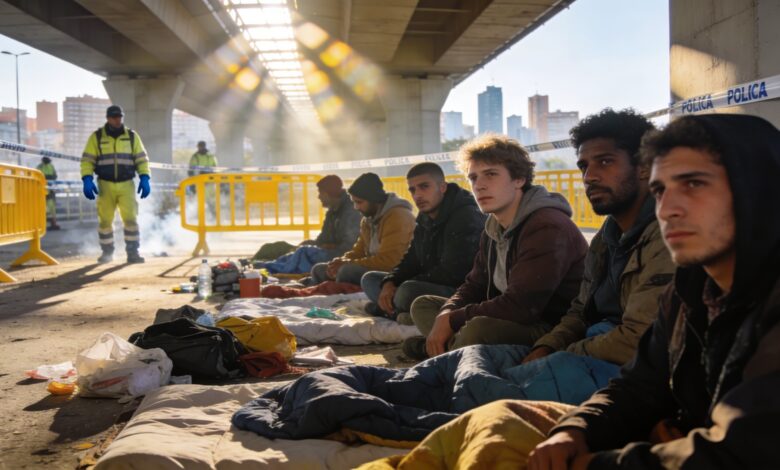
A new wave of struggle for basic rights is unfolding in Badalona: more than 50 local organizations have joined forces to draw attention to the acute housing shortage and rising social tension. The situation escalated after a series of evictions left dozens homeless, already resulting in tragic consequences. For the city’s residents, this is not just another news story—it’s about the future of social policy and how authorities respond to challenges affecting the most vulnerable members of society.
This week, the manifesto “Tenemos un sueño. Badalona justa y digna” was unveiled at the Mare de Déu de Montserrat church, signed by representatives of over fifty community groups. The document was a response to the deaths of five homeless people since the start of the year and the mass eviction from the former B9 institute—the largest informal settlement in Catalonia. According to El Pais, after these events, the burden on the city’s social services increased sharply, and the number of people left on the street continues to grow.
Operation under the bridge
A recent raid under the C-31 bridge sparked particular outrage, as about 30 people—many of whom had previously lived at the B9 institute—were forced to leave their tents. The operation involved the use of chemical agents to clear the area, raising concerns about safety and health. According to El Pais, some of those evicted spent the night on the beach, while others were scattered around the Sant Roc district, forced to sleep on mattresses directly on the street. City authorities justified their actions as a matter of sanitation, but the prosecutor has already accused Mayor Xavier García Albiol of improper eviction procedures—no alternative was offered to the affected people.
The manifesto, drafted through broad public consensus, outlines ten specific demands. These include expanding the network of social services, increasing the municipal housing stock, creating new resources such as reopening the Can Bofí Vell shelter, and organizing a dining facility for those in need. It also calls for simplifying registration for people without a permanent address and improving coordination between different government levels and community organizations. According to the authors, these measures are necessary to prevent further social isolation and to guarantee basic rights for all city residents.
Response and consequences
The situation in Badalona has not gone unnoticed by the opposition: the PSC, ERC, Badalona en Comú, and Guanyem parties are demanding an urgent extraordinary meeting of the municipal council with the mayor. They insist on the immediate reopening of the Can Bofí Vell shelter, which was closed last year, and on finding other solutions to support homeless people. Meanwhile, according to the prosecutor’s office, city authorities still have no clear protocol for assisting those living on the street.
The night after the eviction, a fire broke out under the bridge in the former B9 institute building; fortunately, there were no casualties. The site is now under 24-hour guard by the city police. As noted by El Pais, tensions remain high in the city, and the number of people seeking help continues to grow. A similar situation recently occurred in Barcelona, where residents protested the eviction of a tenant, which also sparked a broad public response— details on the assessment at russpain.com.
Context and trends
The shortage of affordable housing and the growing number of homeless people is becoming an increasingly urgent issue, not only in Badalona but throughout Catalonia. In recent years, the region has seen a rise in evictions without alternative accommodation, leading to increased social tensions and protests. Authorities in various cities are being forced to urgently reassess their social support policies and expand infrastructure for vulnerable groups. In Barcelona, for example, large-scale protests against evictions and calls for the municipality to increase the stock of social housing have become commonplace. Analysts note that without systemic changes, the situation may only worsen and the number of people left on the streets will likely continue to grow.