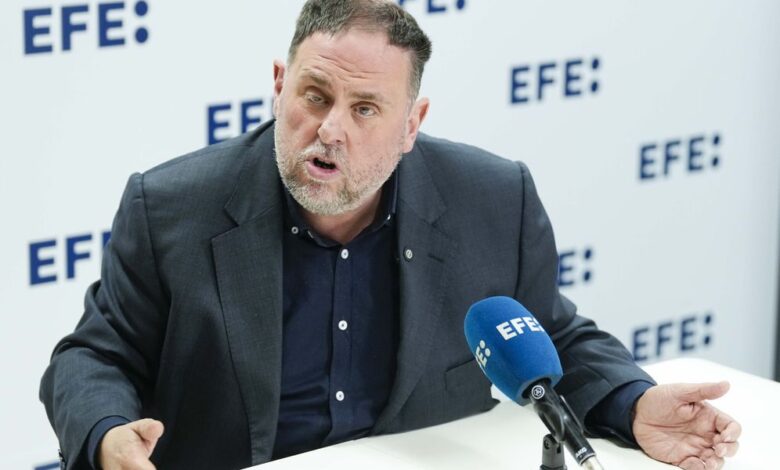
In early January 2026, the residence of the Spanish Prime Minister (La Moncloa) will host a meeting already being called one of the most intriguing in recent years. Pedro Sánchez has invited Oriol Junqueras, leader of the Catalan Republicans (ERC), to discuss reforming the regional financing system. This is their first face-to-face conversation since Junqueras was released under a pardon, and tensions around the event are running high.
The meeting takes place amid a political storm in Madrid. Sánchez’s second term has been marked by the loss of his parliamentary majority, inability to pass key legislation, and mounting scandals within his party. At the same time, ERC is becoming an increasingly important partner for the Socialists, and Junqueras is emerging as a figure who could reshape the course of Spanish politics.
The Catalan conundrum
The main topic on the agenda is a new mechanism for distributing funds among the autonomous communities. Sánchez urgently needs ERC’s support to push through the reform, which is scheduled for discussion in January. Junqueras, in turn, makes no secret of his goals: he wants Catalonia to gain greater control over tax revenues and spending, as well as the right to collect income tax (IRPF) independently.
However, another force stands in the way of compromise—the Junts party, which is categorically opposed to the proposed model. Without their votes in parliament, the reform is doomed to fail. Junqueras publicly urges his fellow Catalan camp members to support the changes, arguing that this is the only way to achieve real improvements for the region. But Junts insists the proposal does not provide Catalonia with genuine financial autonomy and keeps it under the general regime.
Political Stakes
The situation is further complicated by Sánchez’s vulnerability. His government is walking a tightrope, and every new scandal—from corruption cases to allegations of misconduct—undermines trust even within his own party. In this climate, any agreement with ERC becomes more than a budget matter; it is a matter of survival for the entire coalition.
For Junqueras, the meeting is a chance to cement ERC’s status as the main Socialist ally and gain real leverage over the distribution of state funds. He makes it clear: budget support is only possible if Catalonia receives new financial powers. Otherwise, the Republicans are ready to block the government’s key initiatives.
Internal Struggle
In Catalonia, ERC itself is playing a complex double game. In addition to talks with Madrid, Junqueras is simultaneously negotiating with Socialist Salvador Illa over the parameters of the regional budget. For the Republicans, it is important not only to secure concessions from the central government but also to consolidate gains at the local level—for example, by expanding the District Law to smaller towns, modernizing railway infrastructure, and upgrading irrigation systems in Lleida.
However, even if a compromise is reached, its implementation will take time. Changes to the law on regional financing (LOFCA) are not expected to be approved before March 2027. Only then will the regions receive an additional 17 billion euros for their own needs. But if Sánchez decides to call early elections, all agreements could fall apart.
Catalan Front
While ERC and the Socialists search for common ground, Junts is ramping up pressure, accusing the Republicans of being overly conciliatory—even of ‘collaborationism.’ Ahead of the meeting at Moncloa, the rhetoric is hardening: Junts speak of ‘plundering’ Catalonia and are demanding true fiscal independence. Tensions are rising within Catalan society, and the region’s political elites are increasingly calling for a united front in negotiations with Madrid.
However, Junqueras avoids making drastic moves. He favors gradual changes and a pragmatic approach, believing the country cannot remain in a state of political paralysis forever. His strategy focuses on small but tangible victories, even if they fall short of the maximalist expectations of some voters.
Awaiting a breakthrough
In the coming weeks, it will become clear whether Sánchez and Junqueras can agree on a new funding model and secure stability in parliament. At stake is not only the fate of the budget, but also the balance of power in Catalonia and across Spain. If successful, this could mark the beginning of a new era for the autonomous regions. But if negotiations fail, the political crisis will only deepen, strengthening the position of the radicals.
Right now, the entire country is watching this political drama, where the stakes are higher than ever. And it seems no one can predict how this game will end.