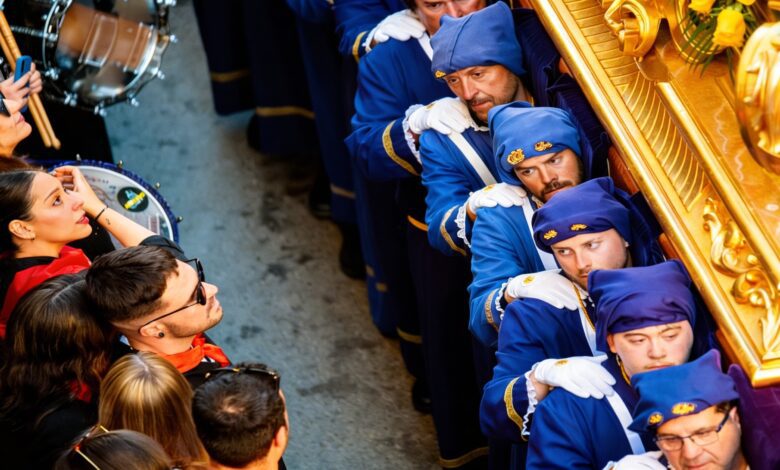
Semana Santa 2026 was not only a time of religious reflection for Spaniards, but also a moment when familiar traditions took on new forms. This year, processions were held in dozens of cities, reaching both major metropolises and small provincial towns. Semana Santa events had a noticeable impact on urban life, transport, and even the regional economy, with photos from the streets clearly showing how perceptions of the holiday are changing.
In Hellín (Albacete), emotions peaked during the Tamborrada: young participants couldn’t hold back tears, while crowds filled the main squares. That same day, dozens of drummers created an unforgettable atmosphere. In Córdoba, inside the Mezquita-Catedral, members of the Entrada Triunfal brotherhood walked through the halls, filling the space with a special meaning. In Málaga, as reported by El Pais, soldiers of the Brigada Rey Alfonso XII de la Legión española carried Cristo de la Buena Muerte y Ánimas on their shoulders, and in Granada, the streets were lit by the procession of Cristo de los Gitanos.
The geography of the processions
Semana Santa spread not only across the south but also to the center of the country. In Toledo, on March 28, the Real Ilustre Cofradía de Nuestra Señora de la Soledad procession took place, while in Huelva the Las tres caídas brotherhood began their march from the Sagrado Corazón de Jesús church. In Logroño, twenty women carried the image of Virgen de Nuestra Señora del Rosario, making it one of the most talked-about moments of the week. In Alcalá de Henares (Madrid), members of the Cofradía del Santísimo Cristo Atado a la Columna left the Carmelitas de la Purísima Concepción monastery, and in Toledo itself, a large procession was held in the city’s main cathedral on Domingo de Ramos.
In Zamora, more than two thousand members of the Real Hermandad del Cristo de las Injurias took a vow of silence on the square in front of the cathedral, symbolizing inner discipline and unity. In Sevilla, the Hermandad de la Estrella prepared to enter the streets, while in Salamanca, the young Franciscan brotherhood chose some of the city’s most iconic historic quarters for their route.
Faces and emotions
Semana Santa 2026 stood out not only for its scale but also for personal stories. In Madrid, on Domingo de Ramos at the Almudena Cathedral, one could see nazarenas in traditional capirotes, while in Pamplona (Navarra), the procession brought together residents of different generations. In Sevilla, members of Hermandad de la Estrella walked to the church to complete their journey. Special attention was drawn to Málaga, where Antonio Banderas once again became the capataz of the Cofradía de Lágrimas y Favores procession, sparking extensive discussions on social media.
Schools did not stand aside: Colegio El Buen Pastor in Sevilla organized its own Semana Santa, demonstrating that the tradition lives on among the youth. As El Pais notes, photos from these events became some of the most discussed in the Spanish media.
Tradition and change
Semana Santa in Spain is not only a religious ritual but also an important part of cultural identity. Each region adds its own features: in some places, the focus is on silence and contemplation, while elsewhere, on music and mass gatherings. In recent years, new forms of participation have become increasingly common, including women’s groups and youth initiatives. An analysis by russpain.com indicates that interest in Semana Santa is growing not only among the faithful but also among tourists, impacting the economy and city infrastructure.
The influence of religious holidays on life in Spanish cities can be compared to how cinema changes perceptions of small towns. For example, after a popular movie was filmed in Monells, the tourist flow increased sharply, as detailed in the article about changes in the Catalan village on the pages of RUSSPAIN.
Semana Santa is traditionally considered one of the most significant spring events in Spain. In recent years, the processions have become increasingly diverse, with new routes emerging, participants changing, and the roles of women and young people growing stronger. In some cities, such as Sevilla and Málaga, Semana Santa attracts thousands of tourists, while locals prepare for the celebration well in advance. In 2025, for instance, Andalusia and Castilla-La Mancha recorded record attendance figures, and in 2024, Toledo and Granada saw unusually high interest in the nighttime processions. These trends confirm that Semana Santa remains a vital part of the country’s cultural life, bringing together generations and regions.