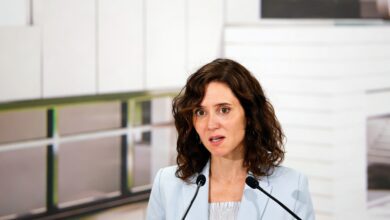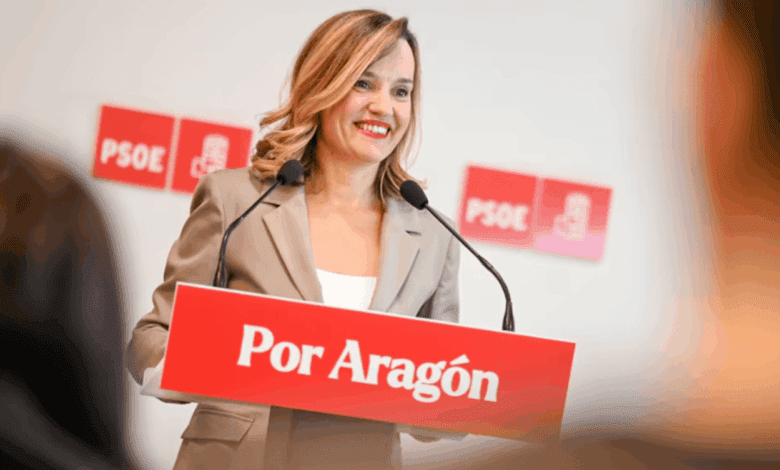
A political intrigue is unfolding in Aragón over the approval of the maximum spending limit for 2026. Pilar Alegría, leader of the regional branch of the Spanish Socialist Workers’ Party (PSOE) and current minister, has unexpectedly offered the government of the Partido Popular (PP) her support on this issue. However, the Socialists immediately set out a number of conditions, without which an agreement would not be possible.
Alegría’s stance comes in response to recent statements from regional president Jorge Azcón, who governs Aragón with only a parliamentary minority. Azcón had earlier warned that if he fails to secure Vox’s support for the budget, the region could face early elections soon. In this context, PSOE decided to take the initiative and offer an alternative to the far right.
Conditions for Support
Pilar Alegría emphasized that she is only willing to negotiate after the government presents more detailed budget calculations, rather than just a PowerPoint presentation. Among the Socialists’ key demands are significant improvements in the education and healthcare systems, as well as extending the tram line to the Arcosur neighborhood. Additionally, PSOE insists on increasing the number of places in nursing homes and providing free preschool education for children from 0 to 3 years old.
Alegría has publicly stated that her party aims to give Azcón a choice: either cooperate with PSOE or remain dependent on the far right. She also reminded that over two years of the current government’s work, the region has faced chaotic decisions and the constant influence of Vox, which, in her view, has had a negative impact on the lives of Aragón residents.
Government response
In response to the socialists’ initiative, Jorge Azcón confirmed that he is open to dialogue with all parliamentary forces. He noted that the coming week would be decisive: it will become clear who is willing to support the budget and who will choose to block the process. Azcón did not rule out the possibility of new elections if a compromise cannot be reached.
At the same time, the head of the region faced criticism from Alegría, who pointed out that despite Aragón receiving 2.8 billion euros from European funds, the government has failed to implement meaningful reforms. According to the socialists, Azcón pursues policies that go against the interests of the people and is unable to negotiate with the opposition.
Negotiations and outlook
In the coming days, Pilar Alegría plans to meet with the president of Aragón as part of consultations with parliamentary groups. During the meeting, she intends to officially present PSOE’s proposals and discuss the possibility of working together on the budget. The socialists believe their conditions reflect the region’s real needs and could form the basis for a compromise.
Among the priorities are reducing wait times in medical facilities, developing housing construction, and supporting young families. Alegría emphasizes: if the government is ready for constructive dialogue, PSOE will not stand in the way of passing the budget, but it will not agree to participate formally without real change.
Political background
The situation in Argón has become a litmus test for all of Spain. With the regional government lacking an absolute majority, every party is trying to use the moment to strengthen its position. For PSOE, this is an opportunity to show itself as a responsible force capable of influencing key decisions, while for PP it’s a chance to avoid reliance on the far-right and maintain stability in the region.
The question of early elections remains open. Everything will depend on whether the parties can reach an agreement in the coming days. For now, residents of Argón are closely following developments, understanding that the outcome of the negotiations will directly affect their daily lives.
In case you didn’t know, Pilar Alegría is one of the most prominent figures in Spanish politics in recent years. She serves as a minister and heads the regional branch of PSOE in Argón. Throughout her career, Alegría has established herself as a proponent of social reforms and an active participant in interparty dialogue. Her current initiative to support the budget under certain conditions could become a turning point in the political history of the region.