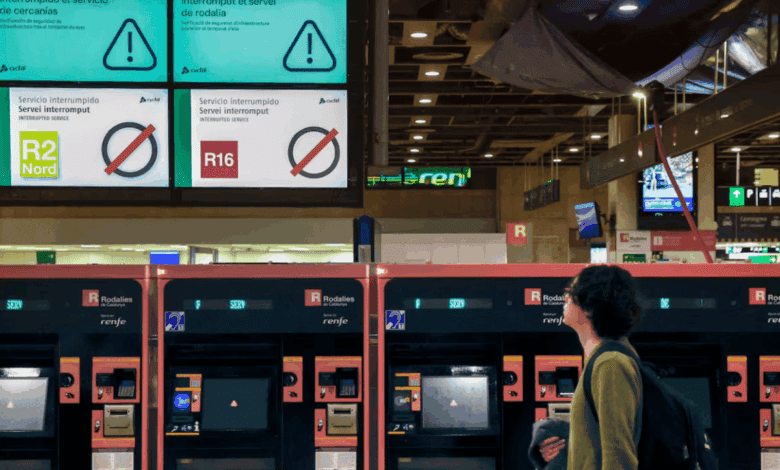
Residents of Catalonia once again found themselves hostage to transport disruptions today as the Rodalies railway network continues to operate with interruptions following the tragic incident in Gelida. For thousands of passengers, this means not only lost time but also complete uncertainty when planning their trips. Train movement restrictions and forced transfers to buses have affected key routes in the region, directly impacting the daily lives and work of many people.
Since early morning, the situation on the railways has been far from stable. Despite statements from Renfe representatives that work is underway to restore the normal schedule, no one is naming specific dates for a return to regular service. Company spokesperson Antonio Carmona compared the current situation to losing a football match, noting the team is ready to fight for improvements, but so far the score is not in their favor.
Restrictions and cancellations
On Thursday morning, ten sections of the railway network were still subject to restrictions, and slow speeds were in effect throughout the system. This led to significant delays and the need to transfer to buses on a number of routes. The problem is especially acute on the R1 line, which connects L’Hospitalet and Maçanet-Massanes via coastal towns. Here, trains only run as far as Blanes, and beyond that passengers are transferred to buses. Between L’Hospitalet and Mataró there are five trains per hour, and between Mataró and Blanes—only two.
The R2 line, one of the most important in the region, connecting Sant Vicenç de Calders and Maçanet-Massanes via Barcelona, is technically operating without interruption. However, on the southern section (R2 Sud) leading to Estació de França, train frequency has been reduced to just two per hour in each direction. This creates additional discomfort for suburban residents and those commuting daily to the capital of Catalonia.
Alternative routes
On the R3 line, which links L’Hospitalet with Puigcerdà via Barcelona, Granollers, Vic, and Ripoll, rail services have been completely suspended. Passengers here are forced to rely solely on buses, significantly increasing travel time and reducing comfort.
On the R4 line, where the tragedy in Gelida occurred, trains run only on certain sections. Between Sant Sadurní and Martorell Central, bus services have been introduced, while from Martorell to Terrassa Estació de Nord, trains operate as scheduled. Further on towards Manresa, passengers again need to switch to buses. This arrangement forces travelers to spend more time and deal with additional inconveniences.
Regional and freight transport
Regional routes have also been affected. The section between Manresa and Cervera is served by buses, as are routes between Reus and Riba Roja d’Ebre, Reus and Vinaixa, and also between Reus and Plana Picamoixons. This means that even residents of remote areas cannot rely on the usual rail connections.
Freight transport is also at risk: the R8 line, which is typically used by cargo trains, remains completely closed. This could impact logistics and supply chains for businesses, potentially affecting the region’s economy in the long run.
Outlook and Expectations
So far, representatives of the railway company are refraining from making specific predictions regarding when full service might resume. Repair and restoration work is ongoing, but passengers must remain patient. Authorities promise to do everything possible to return to normal as quickly as possible, but the situation remains tense.
In recent years, Catalonia’s railway system has repeatedly faced major disruptions. For example, in the spring of 2025, widespread train delays and cancellations already led to a transport collapse, while alternative bus routes could not handle the passenger flow. Such incidents highlight the vulnerability of the infrastructure and the need for modernization. Reflecting on recent events, even short-term interruptions to Rodalies operations spark a strong public reaction and require immediate action from authorities.
Earlier we examined in detail how the transport crisis in Catalonia led to overloaded bus routes and widespread delays. In our feature “Catalonia Faces Transport Collapse: Buses Overwhelmed” explained why the situation spiraled out of control and what measures were taken to stabilize it.