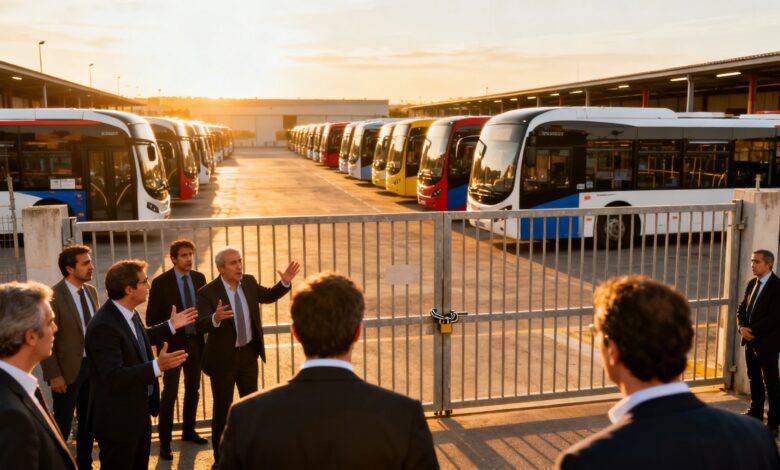
Renfe’s plans to create its own bus company for rapid response to rail disruptions are now at risk. The Direbús association and other industry groups have opposed the tender requirements, arguing they are unfair and limit access for most transport operators. This opposition has already led to the suspension of the project, directly impacting Renfe’s ability to quickly provide alternative transport for passengers.
At the heart of the dispute are the technical requirements for tender participants. Renfe requires applicants to have at least 500 buses, which automatically excludes small and medium-sized companies. According to Direbús representatives, this approach artificially narrows the pool of potential bidders and favors larger market players. As a result, many family-run and regional operators are left out, despite their experience and nationwide presence.
Industry response
Dissatisfaction with the tender conditions has united not only Direbús, but also Fenadismer and Anetra. All have announced their intention to challenge the procedure, and Direbús is considering an appeal to the European Commission. While no official complaint has been filed in Brussels so far, the possibility is being actively discussed. Industry representatives believe the tender violates the principles of fair competition and could lead to a monopoly in transport services during rail incidents.
Renfe, for its part, explains the strict requirements as necessary to ensure the rapid and large-scale transport of passengers in the event of major disruptions. According to them, only large operators can provide the required capacity at short notice. However, as russpain.com notes, this argument failed to convince most market participants, who see the new rules as a threat to their businesses.
Economic risks
Delays in launching the bus company threaten Renfe not only with reputational but also financial losses. The contract is long-term and involves significant investment. While the project remains on hold, the company has to continue operating under the old system—signing one-off agreements with carriers, which does not always allow for quick responses to emergencies. This has become especially evident in recent incidents where passengers faced unclear information and delays when alternative routes were organized.
In February, the situation escalated after a landslide in Álora paralyzed high-speed service between Madrid and Málaga. At the time, Renfe came under criticism for inefficient organization of substitute transport and inadequate customer information. Day-to-day, communication and passenger notification problems remain unresolved, undermining trust in the company.
Competition and pressure
Renfe is facing increasing competition on key routes such as Madrid-Barcelona, where the company’s position has gradually weakened with the arrival of new operators like Ouigo and Iryo. The decline in market share and rising ticket prices are creating opportunities for other players. In response, Renfe has announced major investments in new rolling stock, including the purchase of up to 40 high-speed trains worth more than 1.3 billion euros. However, industry experts believe these measures are more of a reaction to mounting problems than part of a long-term strategy.
Parallels with other infrastructure conflicts in Spain are clear. For example, recently Aena refused to hand control of Basque airports to local authorities, sparking a sharp dispute with regional officials. More details on the development of this conflict can be found in the article about the struggle for control of Basque Country airports.
In the current situation, Renfe is forced to seek a balance between the need for modernization and pressure from the industry. So far, the attempt to create a structured bus transport system has led to a new crisis, further intensifying the sense of instability surrounding the national carrier.
The Direbús Association was established at the height of the pandemic to defend the interests of small and medium-sized transport operators threatened by a sharp drop in demand. In a short time, it united hundreds of companies across Spain, becoming a significant force in the sector. Such associations have repeatedly influenced major infrastructure projects, pushing for revised conditions and the protection of competition. In recent years, similar disputes have arisen in other transport sectors, reflecting the growing influence of professional associations on public policy in Spain.