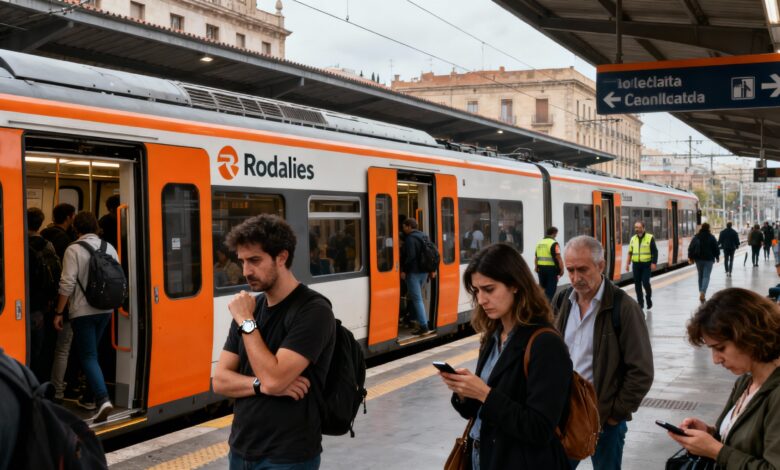
The results of a recent survey on the quality of Rodalies rail services in Catalonia have raised alarm bells among daily commuters. The service received one of the lowest ratings among all forms of public transport in the region, directly impacting residents’ perceptions and trust in the infrastructure management system. The question of who is responsible for the current situation has once again become a focal point of public debate.
Transport ratings
According to a large-scale study involving more than 3,000 Catalonia residents over the age of 16, Rodalies scored just 4.2 out of 10. This is the lowest among all rated types of transport. For comparison, Ferrocarrils de la Generalitat (FGC) received 7.6 points, the metro 7.4, high-speed and intercity trains 7.4, city buses 6.9, and intercity buses 6.6. Even the regional Renfe trains scored 5.5 points, significantly higher than Rodalies.
Young passengers are especially critical of Rodalies. Those aged 16 to 24 gave the service just 3.4 points, while the 25–34 age group rated it 3.8. Only among those over 64 did Rodalies receive an above-average rating of 5.1 points. This suggests that the younger generation feels the transport’s shortcomings most acutely, and perhaps encounters inconveniences more frequently.
Responsibility and politics
The question of who is to blame for the poor condition of Rodalies has divided public opinion. More than half of those surveyed (55%) believe the regional government — the Generalitat — is responsible. Almost 41% place the blame on the country’s central authorities. This polarization of opinions reflects not only dissatisfaction with the service but also the prevailing political sentiments in the region.
Interestingly, a similar trend appears in the evaluation of other sectors: the majority of Catalonia residents believe that responsibility for the quality of education and healthcare also lies with the Generalitat, while the condition of roads and highways is attributed to the central government. This highlights the complex distribution of powers between different levels of authority and the ongoing debates over who should tackle key issues.
Political sympathies
Rodalies enjoys low ratings among supporters of almost all political parties. The only exceptions are PSC voters, who rated the service 5.2 points, and PP supporters, who gave it 6.2. The most critical are users supporting CUP (2.1 points), Aliança Catalana (2.6), ERC (3.5), Junts (3.9), Vox (4.2), and Comuns (4.8). This demonstrates that dissatisfaction with Rodalies unites people with different views, making the problem extend beyond party preferences.
Against the backdrop of low ratings for rail transport, other public services received higher scores. Private schools and educational institutions scored 7.6, public schools 6.8, hospitals 6.8, the Mossos d’Esquadra police 6.7, and Generalitat’s online services 6.6. Even sectors such as social services, administrative offices, and the employment agency received ratings above 6.
Context and consequences
The survey was conducted before the high-profile incident on the R4 line in Gelida, which led to major disruptions on Rodalies and sparked a new wave of criticism. This suggests that actual dissatisfaction with the service may be even greater than what the study recorded. The Rodalies situation has become one of the most discussed topics in the region, and the question of who should be responsible for improving the service remains unresolved.
Problems with the railway network in Catalonia are nothing new. In recent years, residents have repeatedly faced delays, train cancellations, and technical breakdowns. Each such incident triggers a strong public response and prompts new debates about the need for reforms. The question of how quickly and effectively the situation can be changed remains unanswered, while passengers continue to wait for improvements.
Recalling recent events, it is worth noting that disruptions in Rodalies operations have repeatedly sparked public discontent and even political crises. For example, after an accident on one of the lines and the subsequent suspension of service, demands for resignations and reforms intensified in the region. You can learn more about how transport issues in Catalonia have led to high-profile political statements and protests in the article about the recent transport crisis.
In recent years, Catalonia’s transport system has repeatedly come under scrutiny due to frequent disruptions and accidents. Every new incident increases public pressure on the authorities and raises the question of urgent change. Public discontent after major accidents or prolonged train delays becomes a catalyst for debates about reform and the search for new solutions. Such situations have already led to mass protests and sharp political statements, further underscoring the importance of stable public transport for the region’s day-to-day life.