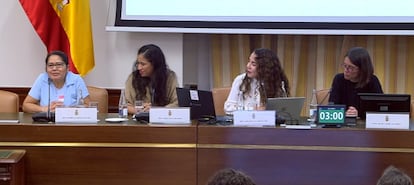
At the start of the week, the walls of the Spanish Congress echoed with the stories of three women who experienced firsthand just how difficult the road to asylum can be. Their testimonies provided a vivid illustration of how administrative delays and protracted procedures can jeopardize not only people’s rights, but their very survival as they seek protection abroad.
María Gallego Calate, who arrived from Guatemala in 2019, found herself unable to support herself and her children after being denied asylum. The pandemic caught her in Spain, where she was working in a nursing home—one of the highest-risk places during the outbreak. Losing her job due to her rejected refugee status pushed the family to the brink of survival. María is now on the verge of finally receiving her long-awaited documents, but her children, now adults, still cannot obtain legal status.
The Gallego Calate family has already endured tragedy: the father was killed during the Guatemalan genocide, while her mother, Ana Calate, was one of the first to fight for the rights of the disappeared. Although victories in international courts followed, they brought constant persecution for the family. But it’s not just political violence that drives women to leave their homeland—dictatorships often create a host of threats for them.
Latin American women: New challenges in Spain
Alongside María, Nora Rugama from Nicaragua and Marta Ramírez from Cuba also shared their stories. All of them have received support from the Guatemalan Women’s Association, which helps them navigate bureaucratic challenges. Lawyer Adilia de las Mercedes presented a report to lawmakers, noting that Spain ranks second in Europe for the number of asylum applications—but has one of the lowest approval rates. In 2024, only 13% of applicants received protection, while the EU average exceeds 50%.
Court proceedings rarely lead to success: only 4.5% of cases are decided in favor of refugees, which is also significantly below European standards. Women who have already endured violence and persecution in their home countries now face new challenges—in the form of endless lines, a lack of available appointments, and a formalistic approach to their cases.
Personal stories: from fighting for rights to facing new barriers
Nora Rugama, who dedicated herself to helping victims of childhood sexual abuse, was forced to flee Nicaragua due to threats from the regime. In Spain, she realized for the first time that she qualifies as a refugee and tried to apply for the status. However, bureaucratic hurdles prevented her even from renting an apartment, and according to her, the appointment system has become virtually inaccessible for ordinary people.
Marta Ramírez, a journalist and activist from Cuba, also faced challenges when trying to access medical care for her daughter. In a country where feminism is seen as unnecessary and women’s rights are supposedly guaranteed, she was forced to leave her homeland to ensure her family’s safety. Her journey to Spain was a reversal of her ancestors’ path, who had fled Spain during the civil war.
Systemic issues and calls for reform
A lawyer from the Guatemala Women’s Association emphasized that handling a single moderately complex case requires up to 125 hours of work—a time commitment most simply cannot afford. Some women wait over a year for the chance to submit documents, unable even to book an appointment. Congress has called for wait times to be reduced to 15 days, for online and phone services to be implemented, and for gender-specific circumstances to be considered to prevent applicants from being retraumatized.
Today, according to participants at the hearings, even the nightly lines that once existed seem fairer than the current system, where the chance to get protection is increasingly out of reach.