The sharp revision of official data on the teachers’ strike in Catalonia came as a surprise to many. The Ministry of Education re-evaluated the participation figures, immediately sparking discussion among teachers and parents. The updated numbers could influence future decisions on the organization of the educational process and the relationship between authorities and the education community.
Data Adjustment
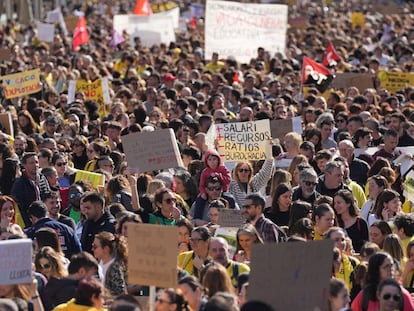
The Ministry of Education of Catalonia has updated the statistics on the strike held on February 11. Initially, participation was reported at 40.94%, but after recalculation, the figure rose to 54.73%. The reason was the inclusion of days when classes were canceled due to weather or days off, which affected the count. Despite the percentage change, the number of schools reporting data remained almost the same—rising slightly from 39.42% to 39.99%.
From the very beginning, there were disagreements between unions and authorities over the scale of the strike. Unions claimed participation reached 85%, while the ministry put the number at nearly half that. Particular discontent arose from the fact that only about 40% of educational institutions reported their figures, whereas this figure usually reaches 80%. In addition, the official statistics combined the data of public and private schools without separating them, unlike in previous mass actions.
Reasons for Discrepancies
According to El Pais, such significant discrepancies in the estimates can be attributed to the sheer scale of the strike itself. This time, not only schools and kindergartens joined the protest, but also institutions for adults, as well as staff responsible for extracurricular activities, food services, and administrative work. As a result, the count included employees from a wide range of categories—from municipal and state workers to those who are not directly under the ministry’s authority.
The Ustec union has criticized the calculation methodology, arguing that even those on sick leave or fulfilling only minimal obligations were included in the total tally. In their view, this artificially lowers the participation rate. Additionally, according to school principals, there were instances in the strike tracking app where the same employee was recorded multiple times, and in some institutions, the number of workers designated to provide minimum services exceeded the actual staff numbers.
Technical and organizational issues
Authorities acknowledge that the final figures included both those assigned to fulfill minimal responsibilities and staff not directly related to the education system. The participation rate for public schools counted all employees, while for private schools only those who reported their involvement were included, since the ministry lacks complete information on private institution staff. As a result, the statistics also encompassed administrative personnel and employees responsible for supporting the educational process.
Trade unions, in turn, rely on their own surveys and data collected directly from schools and teachers across the region. They exclude from their calculations those on sick leave or performing minimal duties to obtain a clearer picture. According to their estimates, 85% of public school staff took part in the strike.
Context and consequences
The teachers’ strike in Catalonia echoes other recent crises where official reports and participant estimates have differed. For instance, after the devastating storm in Andalusia, the authorities were also forced to review the scale of the damage and adjust the budget, as detailed in the article about how the natural disaster changed the lives of local farmers and the region’s tourism sector. Such cases highlight the importance of transparent and accurate information on the scale of events so that society can make informed decisions.
In recent years, Spain has seen a rise in mass strikes in the education sector. These are usually linked to changes in curricula, working conditions, or school funding. In 2022, there was already a major protest against adjustments to the academic calendar, which also sparked debates over the accuracy of official data. Such conflicts between unions and authorities are becoming increasingly common, reflecting mounting tensions within the country’s educational system.