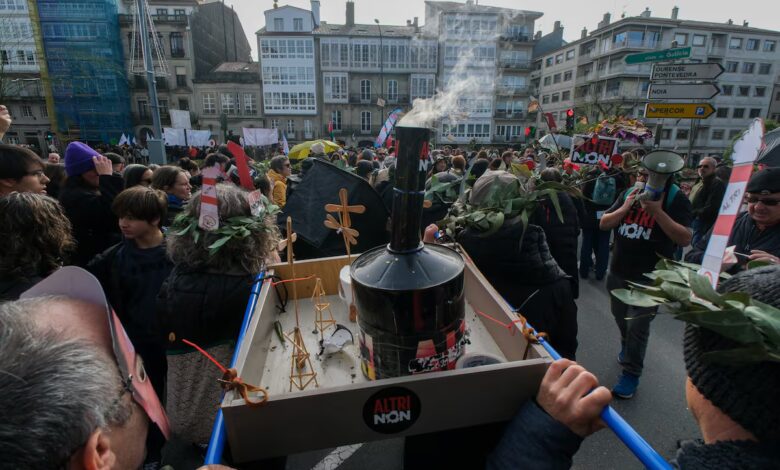
On Sunday, the streets of Santiago de Compostela were filled with thousands of Galicians protesting plans to build a large pulp and textile fiber plant in Palas de Rei (Lugo). Demonstrators chanted “Altri non” in opposition to a project they believe threatens the region’s environment and the future of the Ulla River.
The protest was organized by groups including the Ulloa Viva platform and associations that defend the ría de Arousa. Organizers note that, despite financial difficulties faced by investors, the project has not been fully scrapped. According to them, the strong turnout sends a message to authorities and business leaders that the local community will not accept the potential consequences of the plant’s construction.
Environmental concerns
The plant project calls for an annual output of 400,000 tons of dissolving pulp and 200,000 tons of sustainable textile fibers. To do this, it would occupy 366 hectares of land and extract up to 46 million liters of water daily from the Ulla River, raising alarms among environmentalists and fishermen. They fear the large-scale water withdrawal and subsequent discharges could cause irreparable harm to the ecosystem and the ría de Arousa, an area traditionally known for shellfish harvesting.
Although the project has already received a positive environmental impact assessment from regional authorities, its implementation has stalled due to lack of funding. Investors were counting on €250 million in government subsidies but were twice denied access to European funds. Additionally, the plant is not yet connected to the power grid, putting the launch in doubt.
Politics and society
The demonstration in Santiago drew members of opposition parties, trade unions, environmental organizations, and fishing cooperatives. Movement leaders emphasize that the Altri project not only threatens the environment, but could also lead to economic losses for local residents who depend on traditional industries.
Marta Gontá, a representative of Ulloa Viva, stated that construction of the plant would bring the region not development, but poverty. According to her, Galicia deserves more sustainable and environmentally safe investments. Representatives of Greenpeace also joined the protest, calling on Altri to publicly abandon its plans.
Government response
The head of Galicia’s autonomous government, Alfonso Rueda, acknowledged that the fate of the plant remains uncertain. He noted that due to financial and technical difficulties, the company must independently decide its next steps. Meanwhile, the opposition accuses the regional authorities of lobbying for big business at the expense of local interests.
BNG leader Ana Pontón called the Altri project an example of ‘industrial Francoism’ and urged the government to listen to public opinion. Socialist representative Lara Méndez recalled that Spain’s central government has three times refused to support the plant, including by excluding it from the country’s national energy development plans.
The future of the project
Two years ago, the project’s initiators applied for permission to draw water from the Ulla, but have yet to receive approval. Environmentalists consider this to be one of the most dangerous aspects of the project, as it could alter the river’s hydrology and affect the lives of thousands who rely on fishing and agriculture.
Despite all the obstacles, activists emphasize that they have no intention of stopping. They are demanding that Altri officially abandon the construction plans and are urging authorities to seek alternative ways to develop the region that do not threaten the environment or traditional way of life.