In the coming years, residents of Catalonia will face major changes in transport and urban infrastructure. The project to extend the tram line between Sant Adrià del Besòs and Badalona, covering the future Tres Chimeneas district, aims not only to improve connections with Barcelona but also to transform the approach to urban space. New solutions in ecology, transport, and housing could set an example for other regions of Spain.
Transport and new streets
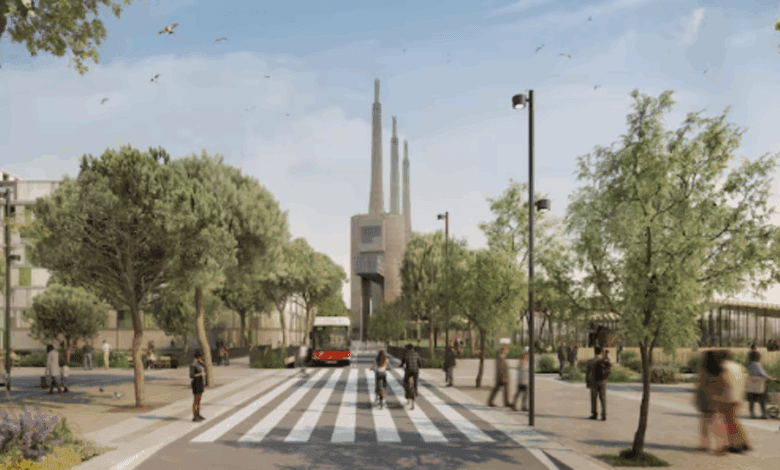
As El Pais notes, the Generalitat has revived a plan, discussed since 2021, to build an additional 1.4-kilometer section of tram tracks. This stretch will feature two new stops: one near the iconic Tres Chimeneas chimneys, the other by the port of Badalona. The route will run alongside the railway tracks along Eduard Maristany street. The informational project has already been approved, and the new stations are scheduled to open in 2033.
At the third meeting of the Catalunya Media City development commission, the first visualizations of future streets were unveiled. Special emphasis is placed on environmental solutions: the roadways will be equipped with rainwater collection systems, along with dedicated crossings for cyclists and pedestrians. The Batlle i Roig architecture studio, responsible for the project, highlights that the streets will be rich in greenery and capable of handling heavy rainfall—a crucial factor for the coastal area, which is prone to flooding.
Housing and economy
Alongside transport changes, preparations are underway for the construction of a new residential district. Over the next few years, 1,700 apartments are planned to be built on a 32-hectare site, with provisions to support business development. The redistribution of land among owners is a key stage that should be completed by the end of this year. The main proprietors are local administrations and the company Front Marítim, which includes Endesa and Metrovacesa.
Urban development will be implemented in six stages, set to begin in 2028. During the same period, provided the power substation is successfully relocated, initial housing construction could commence. Private traffic will be routed underground along the Maresme avenue, while two new green overpasses will link the coastal and hillside parts of the district, offering convenient access for pedestrians, cyclists, and service vehicles.
Catalonia as a hub for audiovisual technologies
The Catalunya Media City project is considered strategic for the region. According to adviser Albert Dalmau, the goal is to turn Catalonia into the leading audiovisual hub in Southern Europe. Talks with industry companies are already underway, and by 2028, a training center is set to open in the former turbine hall, capable of accommodating up to 2,500 students in professional and higher education programs.
An important part of the initiative is the agreement to expand the Parc Audiovisual de Terrassa studios. Two new pavilions of 2,200 and 1,000 square meters will be built here, with a budget of 13 million euros, 10 million of which will be provided by the Generalitat. This will increase production capacity and attract new projects to the region.
Context and outlook
After the Tres Chimeneas urban development plan was approved in 2023, project management was transferred to the Department of the Presidency. Catalunya Media City is considered the most significant project for the region since the 1992 Olympic Games. Attention to details such as eco-friendly streets and the integration of new transport solutions highlights Catalonia’s commitment to innovation and sustainable development.
In recent years, Spain has actively invested in upgrading its transport infrastructure. For example, construction recently began on a new metro tunnel in Madrid that will link the southern and eastern districts of the capital. This is discussed in detail in the article about the largest metro expansion in Madrid. Such projects show that the country’s major cities are focusing on modern solutions for transportation and the urban environment.
In recent years, Spain has been implementing large-scale projects to develop urban areas and transport networks. Barcelona and Valencia are introducing eco-friendly tram lines and new residential neighborhoods focused on sustainability. Malaga and Zaragoza are also working on modernizing public transport and creating green spaces. These initiatives reflect a broader trend toward improving quality of life and adapting cities to climate challenges.