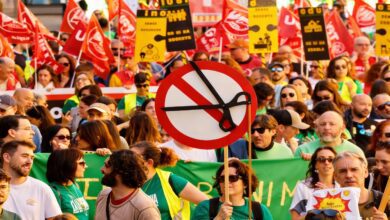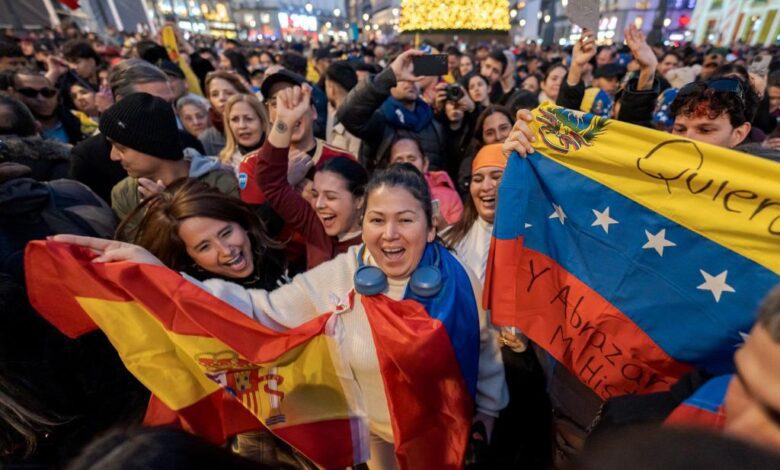
On this evening, Puerta del Sol in Madrid was transformed into a true island of freedom for the Venezuelan diaspora. The crowd, where young and old came together—those who had only recently left Caracas and those long settled in Spain—did not hide their emotions. People embraced, laughed, some couldn’t hold back tears, while others called family in Venezuela to share the moment. The air was filled not just with joy, but also with the sense that history had finally turned toward those who had lived in exile for so many years.
At the center of attention was an unusual symbol—a figure of Maduro (Maduro) in handcuffs, shaped like a banana. It was passed from hand to hand like a trophy, with everyone eager to touch this sign of change. The celebration was so heartfelt that even tourists who came to see the Christmas lights were unwittingly swept up in the event. Some danced to lively rhythms, some waved flags, while others simply stood aside, watching the dreams of thousands come true.
Voices of Freedom
From an improvised megaphone came the shouts: “We are here for freedom! We are here for everyone in prison! We will return to Caracas!” These words echoed across the square, louder than even the music. For many, this day was the climax of years of waiting. Carlos Rangel (Carlos Rangel), who left Venezuela back in 2003, couldn’t hold back tears: “I have waited so many years for this moment. I cried and I keep crying from happiness.”
Among the crowd were those who cannot return home for fear of arrest. For example, Xiomara Pérez, who worked with María Corina Machado, admitted: “This is the greatest gift of my life. I can’t go home; I’d be jailed immediately.”
Spanish sanctuary
According to official data, more than 400,000 Venezuelans live in Spain, nearly half of them in Madrid. In reality, the number is likely higher, as not everyone is officially registered. Madrid has become more than just a new home for many—it’s a true refuge. Prominent opposition politicians have found shelter here, along with ordinary people fleeing repression. Venezuelan shops, cafes, and bakeries have opened throughout the city, becoming gathering places for the community.
That evening at Puerta del Sol, there were entrepreneurs, activists, and people simply tired of living in fear. They all understood: there are still many challenges ahead, and the road to freedom won’t be easy. But tonight, they allowed themselves to forget their worries and simply celebrate.
A new hope
Among the crowd were calls to restore the results of the 2024 presidential election, in which Edmundo González won. “Venezuelans spoke clearly on July 28. We want Edmundo as president, because the narco-regime stole power,” announced Juan Antonio Vega, coordinator for Vente Venezuela in Spain, through a megaphone.
Carlos Rangel, owner of a small shop on Montera Street, didn’t hide his gratitude to Donald Trump: “Only force could remove these people. There was no other way.” His words resonated with many who had grown tired of waiting for peaceful change.
Faces of Change
Betty Alonso, owner of the La Cachiterie bakery, spoke openly about her hopes: “It was a surgical operation. The strikes hit weapons warehouses, which had been supplied from Iran, Russia, and China.” She believes everything began when María Corina Machado was awarded the Nobel Peace Prize: “From that moment on, a light was lit for Venezuela.”
People in the crowd discussed not only the fall of the regime, but also possible consequences for other countries. Some are certain that other leaders, as well as Spanish politicians who supported the regime, will follow Maduro. But no one was quick to name names—there is still too much uncertainty.
Tears and Anticipation
José Antonio Melián, owner of the Galipán fast-food chain, admitted he still can’t believe what’s happening: “I woke up to calls and messages. My heart aches, I’m on the verge of tears. People I haven’t spoken to in years are congratulating me.” He has no illusions: a tough transformation lies ahead, since corruption had infiltrated every sphere of life. But today, like thousands of others, he allowed himself to hope for a future without fear or despair.
That evening, Puerta del Sol left no room for indifference. Everyone who gathered there felt part of something momentous. Despite the uncertainty ahead, the main thing was the belief that returning home was now a little closer.