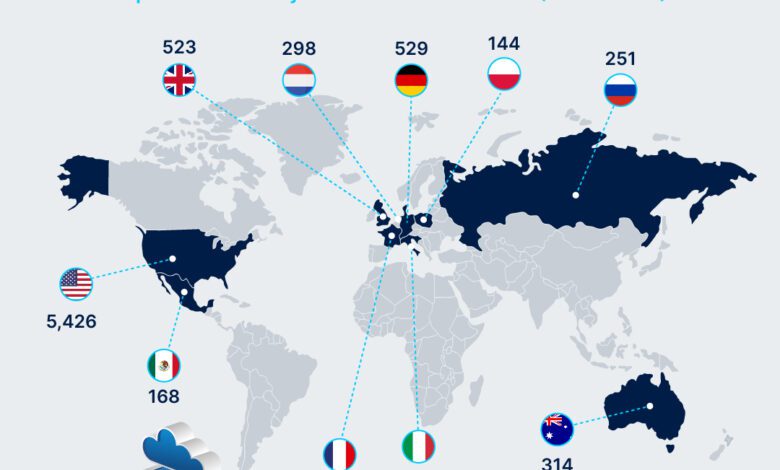
Global Data Center Map: Who’s Setting the Pace
The modern digital landscape is unimaginable without data centers. These facilities ensure the uninterrupted operation of online services, mobile apps, and cloud platforms. In 2025, the United States remains the undisputed leader with 5,426 data centers in operation. Germany, the United Kingdom, France, Australia, and the Netherlands also rank among the countries with the most advanced data storage and processing infrastructure.
Germany holds second place with 529 centers, followed by the United Kingdom (523), France (322), Australia (314), and the Netherlands (298). Russia, Italy, Mexico, and Poland are also showing significant growth in this sector, investing in new facilities and expanding existing capacity.
Tech Trends and Market Growth
The data center market is experiencing rapid development, driven by the adoption of cloud computing, artificial intelligence, the Internet of Things, and 5G networks. Companies across all industries are seeking reliable, fast, and secure digital infrastructure. Forecasts suggest that by 2033, the global data center market will more than double—from $239.55 billion to $524.81 billion.
The US is seeing diversification in data center types: from cloud and hyperscale to colocation and enterprise facilities. In 2023, American data centers consumed 176 terawatt-hours of electricity, accounting for 4.4% of the nation’s total energy use. By 2030, that share could rise to 12% driven by the growth of AI and cloud services. Water consumption remains significant as well — 1.7 billion liters are used daily, though this is only a small fraction of the national total.
European hubs: scale and distinctive features
Germany remains Europe’s largest digital hub. Its data center capacity exceeds 2,700 megawatts and could reach 4,800 megawatts by 2030. Frankfurt stands out as a key node thanks to its location and the major internet exchange point DE-CIX. The country is dominated by Tier III facilities, combining reliability with optimized costs. Edge and modular solutions are gaining momentum, enabling rapid deployment of local capacity.
In the UK, most data centers are concentrated in London and along the M25 ring road, with Manchester emerging as the second most important hub. By 2030, total UK data center capacity may rise from 2,590 to 4,750 megawatts. As in other countries, the number of colocation and hyperscale sites is also increasing.
France is betting on Paris and Marseille, where the combined data center power reaches 953 megawatts. The country mainly relies on cloud and colocation solutions, with sustainability issues gaining increasing importance.
Asia-Pacific region and new players
Australia is experiencing rapid growth in the data center market, especially in Sydney and Melbourne. The expansion of cloud services and artificial intelligence is turning these cities into major magnets for investment. In the Netherlands, where Amsterdam leads the sector, capacity is expected to reach 1,480 megawatts by 2030. Most facilities here also comply with the Tier III standard.
In Russia, most data centers are concentrated in Moscow and Saint Petersburg, with a total power of 3.6 gigawatts. Italy, though smaller in scale, is actively expanding: in 5–7 years, the market could grow from 300 megawatts to 1.5 gigawatts, with Milan becoming a focal point for new projects.
Mexico is investing in new facilities and expects to exceed 600 megawatts by 2030. The main growth areas are Mexico City, Querétaro, and Guadalajara. Poland is also increasing its capacity: by 2030, its figure could rise from 441.8 to 713.3 megawatts, with Warsaw emerging as the main development hub.
Who manages the infrastructure
Global leaders — Google Cloud, Microsoft Azure, and Amazon Web Services (AWS) — continue to expand their presence across all key regions. Their solutions enable companies to rapidly scale digital operations and ensure high service availability. Among regional providers, OVHcloud, NTT, Equinix, and Digital Realty stand out; they are also actively investing in new facilities and technologies.
Demand for reliable, secure, and sustainable infrastructure increases every year. Countries compete for investment and technological leadership, striving to create the right environment for the digital economy to grow. In the coming years, data centers will remain at the heart of global transformation, supporting the adoption of new technologies and ensuring the resilience of digital services.
In case you didn’t know: What is Amazon Web Services
Amazon Web Services (AWS) is the world’s largest provider of cloud computing and infrastructure solutions. Founded in 2006 as a division of Amazon, it quickly became the market leader thanks to innovative services and scalable business solutions. AWS offers a wide range of products: from virtual servers and data storage to artificial intelligence and analytics tools.
Today, its data centers are located around the world, serving clients that range from startups to major corporations. AWS is actively investing in the development of new technologies, with a strong focus on security and energy efficiency. The company regularly launches new regions and availability zones to ensure low latency and high performance for its users. Thanks to the flexibility and reliability of its services, AWS has become a key player in the digital transformation of businesses and the public sector. Its solutions enable companies to quickly adapt to changing market demands and implement innovations without significant capital expenditures.