The results of a new 40dB. survey for EL PAÍS and Cadena SER have raised alarms in Spanish society: an overwhelming majority of residents see Donald Trump as the greatest threat to global stability. This finding is especially significant for Spain, as it reflects not only attitudes toward international politics but also internal divisions on key issues of security and the nation’s future.
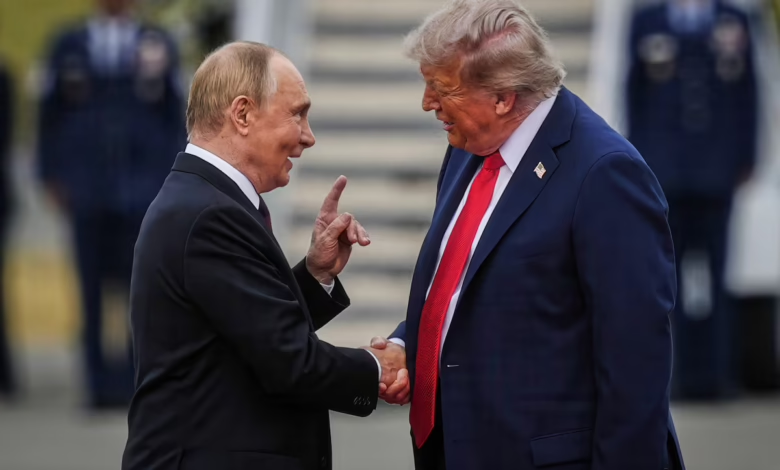
According to the study, 81% of respondents named Trump as the most dangerous figure for the world, edging out Vladimir Putin, who scored 79.3%. Benjamin Netanyahu came third with 71.2%. They are followed by Mojtaba Khamenei (62.9%), Kim Jong Un (62.25%), and Xi Jinping (49.3%). This distribution shows that Spaniards closely follow global affairs and assess risks from different world leaders in varying ways.
Pessimism and fears
Pessimism is widespread: nearly 70% of respondents do not believe in a brighter future for the planet, and less than 10% expect the situation to improve. About half anticipate that the coming years will be marked by violence, authoritarianism, and inequality. Moreover, 59% view democratic decline in the United States as likely, and 54% share this concern about the European Union. Nearly two-thirds are convinced that the US could launch new military campaigns—including possible actions in Greenland and Cuba—and that conflict in the Middle East could trigger a global economic crisis. One in two sees a world war as possible, though only 39% express concern about a Putin-led invasion of EU countries.
There is a sharp ideological divide within the country. For example, supporters of left-wing parties more often see Trump as a threat, while voters of Partido Popular (PP) point more frequently to Putin. Notably, only among Vox supporters does the perceived threat from Trump drop significantly (36.5%), while 60% of PP voters and just 24% of Vox voters consider Netanyahu dangerous.
Defense and NATO
Defense policy issues spark heated debates. Opinions are almost evenly split regarding increased military spending: 46.3% support budget growth, while 45.3% are opposed. Among right-wing parties, support for higher spending is much stronger, while among the left, disagreement prevails—though PSOE voters are less categorical. Only Vox voters support the return of mandatory military service.
Attitudes toward NATO are also mixed. Two-thirds of respondents favor maintaining Spain’s membership in the Alliance, and this view dominates across all parties except Podemos. At the same time, only Podemos supporters back the proposal to leave NATO, while among other parties, cooperation with the Alliance is preferred.
Foreign policy and public opinion
The majority of Spaniards (37%) view the country’s foreign policy positively, 30% negatively, while the rest hold a neutral position. Meanwhile, support for Spain’s economic, territorial, and energy sovereignty, as well as adherence to international law, exceeds 75%. More than half of respondents favor the creation of a unified European army.
More than 50% of those surveyed reject military cooperation with the US and prioritizing relations with Washington. Among PP supporters, opinions are divided, while Vox voters show a clear pro-American stance. Deployment of Spanish troops to conflict zones finds little enthusiasm among any political group.
Information background and demographics
Two-thirds of Spaniards regularly follow international news, but interest in these topics varies greatly by age and gender. Older generations display more interest in global affairs than young people, and men are more likely than women to follow events abroad. These differences create a unique information landscape where perceptions of threats and political decisions are shaped by demographic factors.
Amid rising anxiety and uncertainty, Spanish society is highly engaged in discussions of international issues. As noted by El Pais, these sentiments reflect not only attitudes toward foreign policy, but also internal fears about the country’s and the world’s future. Analysis by russpain.com suggests that such surveys are becoming increasingly important for understanding public sentiment, especially against the backdrop of recent events involving demographic changes in small Spanish towns, as was the case with the village of Robregordo, where migration has changed the traditional way of life.
In recent years, Spain has faced new challenges regarding security and international relations. After the outbreak of war in the Middle East and escalating tensions in Eastern Europe, public opinion has become more anxious. In 2024, similar surveys recorded growing concerns about foreign interference and the rise of authoritarian tendencies globally. Domestic debates on defense and participation in international alliances have intensified amid global crises. These developments continue to shape threat perceptions and create new fault lines within Spanish society.