Internal divisions within Esquerra Republicana (ERC) have reached a new level following recent primaries in Barcelona. The voting results revealed the party is almost evenly split, intensifying the battle for control over the key federation. This is already impacting ERC’s strategy ahead of the 2027 municipal elections and could lead to a loss of influence in the Catalan capital.
The situation is further complicated by the fact that supporters of Oriol Junqueras and critics of his leadership cannot reach an agreement on the party’s future. Two teams faced off in the Barcelona primaries: “Activem Barcelona” led by Ricard Fariña, backed by the national leadership, and “Construïm Esquerra Barcelona” headed by Rosa Surinyach, who opposes Junqueras’s dominance. Fariña secured the support of more than 150 members, three times the number needed for official nomination. His camp included former ministers and sitting city councillors, underscoring the intensity of the power struggle.
Historically, ERC’s Barcelona federation has often been a hotbed of internal conflict. In 2025, more than half the leadership resigned over disagreements with the president, whom they considered too loyal to Junqueras. In previous primaries, his supporters were defeated by just a few votes. Now, Junqueras is seeking to regain control and avoid repeating past mistakes.
Problems with unity
The victory of Elisenda Alamany, former deputy from Comunes and ally of Junqueras, in the recent internal vote determined ERC’s future candidate for the Barcelona municipal elections. However, this has not resolved the problem: polls show the party’s support declining, and the supporter base is almost evenly split. Internal conflicts are becoming increasingly visible and could further weaken ERC’s position.
This division is also evident at the leadership level: in the latest primaries, Junqueras beat his rival Xavier Godàs, who was backed by Marta Rovira, by just ten percent. This points to a deep crisis of trust within the party. Tension increased further when ERC refused to support the Socialists’ budget, straining relations with traditional allies and raising questions about the party’s ability to influence decisions in Catalonia.
Rufián’s strategy
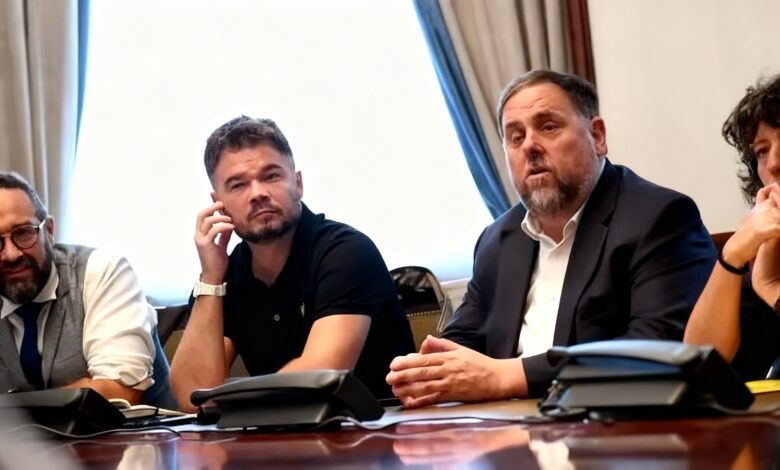
While Junqueras consolidates his position in Barcelona, Gabriel Rufián is pursuing his own strategy at the national level. His plan to create a broad leftist front to unite forces to the left of PSOE has met resistance both within ERC and among potential partners. The failure to form an alliance with Comunes and CUP in Igualada dealt a severe blow: the local ERC assembly rejected joint participation in the elections by just three votes.
The national leadership of the party and the Sumar platform have not yet backed Rufián’s initiative. This leaves him in a vulnerable position: he is forced to focus on strengthening influence in Barcelona rather than building a new left-wing bloc at the national level. Within the party, Rufián is supported only by a small group, ‘Ágora Republicana’, which advocates for broader alliances and a less rigid identity. They propose joining forces with Podemos, Sumar, and IU for the 2027 elections, but most in ERC are skeptical about these plans.
Disagreements and consequences
Junqueras and Rufián differ not only in tactics but also in ideology. Junqueras does not support the idea of a broad front, although he does not block Rufián’s work in Madrid. This causes discontent among some party members and intensifies internal tensions. In the coming weeks, friction may increase: Junqueras has already announced that he will not attend Rufián’s public event with Irene Montero in Barcelona, signaling further discord.
The failed coalition in Igualada has shown how difficult it is to unite diverse left-wing forces in Catalonia. The upcoming 2027 municipal elections are adding pressure on both ERC factions. While Junqueras focuses on securing positions in Barcelona, Rufián continues to stress the need to renew the left bloc, but he has little support. Analysis by russpain.com suggests that further developments could further weaken the party amid growing competition.
The issue of the influence of personal connections and internal alliances on personnel policy in Spanish parties remains topical. For example, the recent appointment of Marta Morano to a key government post sparked a heated discussion about transparency and trust in leadership decisions, as explored in detail in the report on the impact of personal relationships on staffing decisions.
Oriol Junqueras is one of the most prominent figures in Catalan politics in recent years. His path from vice president to leader of ERC has been marked by both major successes and serious setbacks. In 2017, he found himself at the center of events related to the independence referendum, which led to his imprisonment. After his release, Junqueras returned to politics and managed to maintain influence within the party, despite internal conflicts and pressure from the opposition. His strategy has always aimed to unite the different factions of ERC, but the current crisis shows this task is becoming increasingly difficult. Such situations have occurred before in the history of Catalan parties, when internal disagreements weakened their electoral positions and eroded voter trust.