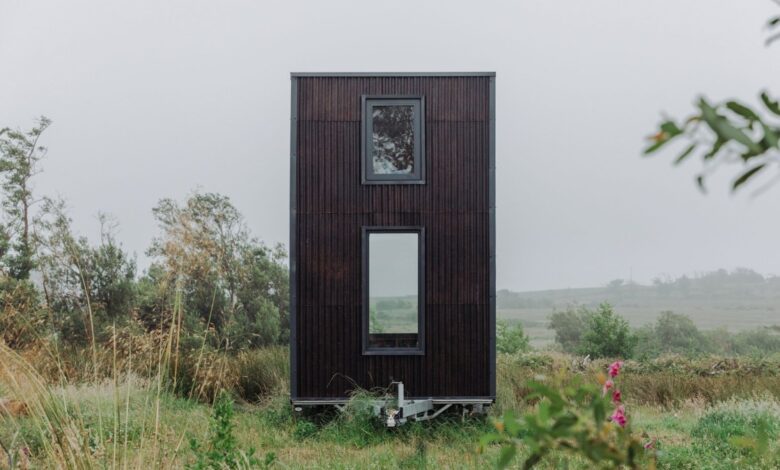
A new alternative for young families
As rental prices continue to rise and mortgages become harder to obtain, an unconventional type of housing is gaining popularity in Ireland. Tiny mobile homes made from natural materials are increasingly sought after by young people looking for independence without tying themselves to long-term loans. This approach not only helps cut costs, but also offers freedom from the traditional real estate market.
Eco-friendly technology and modern design
The Tigín Tiny Homes project was launched with the participation of Common Knowledge, an organization specializing in low-carbon construction training. Together with hemp producer Margent Farm, they developed compact homes of about 20 square meters. Construction uses hemp fiber panels, cork insulation, and natural linoleum. Thanks to this combination of materials, the homes achieve high energy efficiency and minimal environmental impact.
The tiny house interior is organized across two levels. The ground floor features a living area with a window seat, a compact kitchen, a bathroom with a shower, and a space for storage or work. Stairs lead to the upper level, where a spacious loft bed is located. Large windows provide plenty of natural light and make the space feel bigger, while a composting toilet and off-grid electricity system offer maximum independence.
Education and open access to technology
In response to the annual rise in housing prices, which reaches 11% in Ireland, the project organizers are focusing on education. Common Knowledge offers workshops where participants learn carpentry, masonry, welding, and bio-construction skills. This enables anyone interested to build their own tiny houses, using open-source blueprints and material lists that the organization plans to make freely available.
A fully finished home costs around 55,000 euros, but building it yourself can significantly reduce expenses. This approach gives young people a way out of the rental trap and the chance to own a home without taking on large loans.
Development prospects and market impact
The Tigín Tiny Homes project proves that affordable and eco-friendly housing can be a reality, not just a distant dream. Thanks to their mobility and simple design, these homes are suitable for both temporary and permanent living, and can also be used as holiday cottages or guest houses. The organizers believe that open access to technology and educational programs will help spread this experience to other European countries as well.