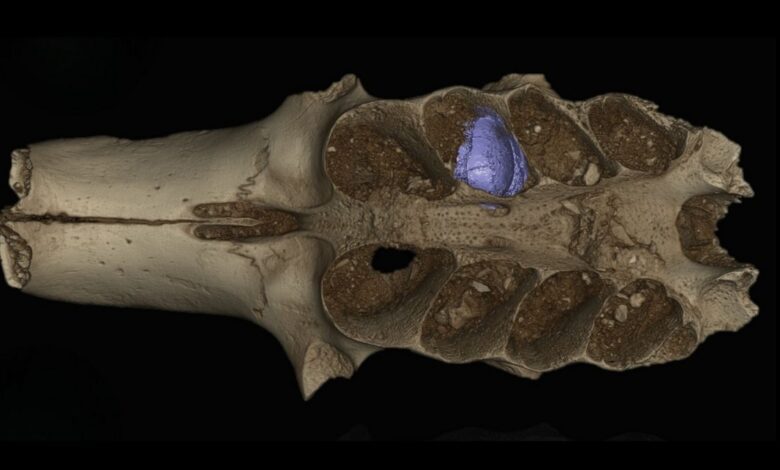
In a cave on the island of Haiti (Haiti, Hispaniola), researchers made a remarkable discovery: traces of bee activity were found in the jawbone of an ancient rodent, with the insects nesting directly in the empty tooth sockets. This is the first recorded instance of such behavior in extinct insects, and the finding has already sparked considerable discussion in the scientific community.
Paleontologists believe the bone belonged to a large rodent similar to modern capybaras, known as Plagiodontia araeum. According to one theory, the animal was preyed upon by an owl that brought it into the cave and, after feeding, left the jaw among the sediments. Over time, the teeth fell out, and bees of a species new to science, Osnidum almontei, settled in the empty cavities.
An unusual home
What caught the scientists’ attention was the unusually smooth surface inside one of the tooth sockets. Using a microtomograph, researchers discovered evidence of repeated use — bees had returned to the same spot for several generations. This indicates a strong site fidelity for nesting, a trait not previously observed in similar species.
After the initial discovery, experts began to closely examine other bones found in the same sediment layer. It turned out that similar nests were found not only in rodent jaws but also, for example, in the bones of extinct sloths. Bees used any suitable cavities to create a secure refuge for their offspring.
Traces of the past
Scientists note that these are so-called ichnofossils—fossilized traces of organism activity, not the creatures themselves. Nevertheless, such finds offer new insights into the behavior of ancient insects and their ability to adapt to unusual environments.
The study showed that Osnidum almontei were extremely resourceful: they filled all available bone cavities in the cave’s sediment deposits. The high density of nests suggests that this location served as a kind of “dormitory” for solitary bees for a long time—they did not build their own hives, but preferred to use pre-existing spaces.
Technology and Discoveries
Modern scanning techniques played a crucial role in studying the find. Thanks to micro-computed tomography, researchers examined the nests’ internal structure, as well as tracked changes in their size and shape over time. This revealed that the same chambers were reused by multiple generations of bees.
Paleontologists emphasize that such discoveries expand our understanding of past biodiversity and how insects may have exploited the most unexpected resources to survive. In the future, scientists plan to continue searching for similar traces in other regions of the Caribbean.
Significance of the Find
The discovery of bee nests inside the bones of extinct animals not only astonished experts but also made a significant contribution to the study of ancient island ecosystems. Finds like these shed light on how complex relationships between different species formed and how insects adapted to life in resource-limited environments.
The study was published in a leading scientific journal, and the discovery has already become a topic of discussion at international conferences. Scientists are confident that many more surprises related to the behavior of ancient Caribbean inhabitants await them.
In case you didn’t know, Osnidum almontei is a recently described species of solitary bee discovered in deposits on the island of Hispaniola. It was named in honor of researcher Almonte, who participated in the excavations. Paleontologist Lazaro Viñola Lopez and his team from the Florida Museum of Natural History specialize in studying fossilized traces of animal and insect activity. Their work helps uncover unknown chapters in the history of the Caribbean and the evolution of its ecosystems.