The medieval settlement of Salomatovo I, located on the steep banks of the Usva River, puzzled archaeologists for years. Its unique position—with a sheer cliff on one side, deep ravines on the others, and powerful earth ramparts—made the settlement nearly impregnable. Covering about 10,000 square meters, archaeologists discovered a complex cultural layer where traces from different eras overlapped, creating a true historical puzzle. For a long time, scholars debated when exactly this settlement existed and who its inhabitants were.
The first attempts to date the settlement were made back in the 1930s based on ceramic finds; at that time, the site was attributed to the 10th–12th centuries. However, later research revealed that the history of Salomatovo reaches much further back. It was only in 2012 that radiocarbon analysis provided a precise answer: the settlement existed from the 8th to the 14th century, reaching its peak in the 11th–13th centuries. Still, the question of the cultural and ethnic identity of its inhabitants remained unresolved.
Cultural Diversity and Archaeological Debate
For decades, scholars have put forward various theories about which culture the inhabitants of Salomatovo belonged to. Initially, the settlement was linked to the Chepetskaya culture, later to Sylvenskaya, and more recently to the Lomovatovo-Rodanovskaya community, which united Finno-Ugric peoples engaged in agriculture, crafts, and metallurgy. Ceramic analysis also revealed traces of the Nevolinskaya culture, whose representatives practiced a mixed economy and partially migrated to this area in the 9th century. This sparked debates: did cultures simply replace one another, or was a unique symbiosis of different traditions formed here?
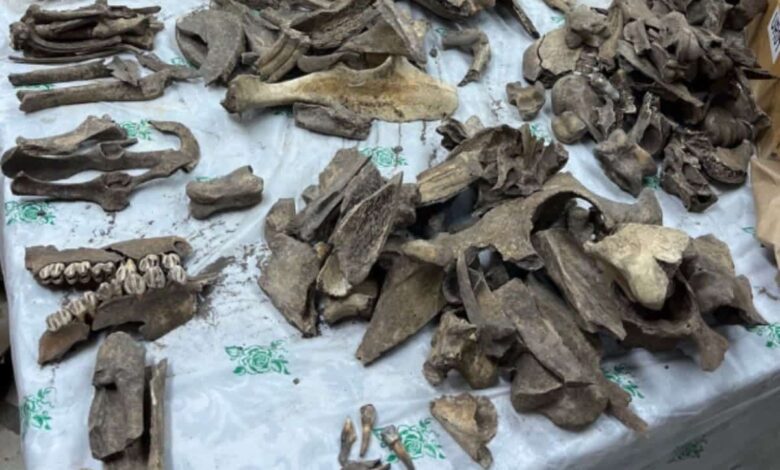
Modern research methods, including archaeozoology, have offered a new perspective on the issue. The study of animal bones found in cultural layers has made it possible to reconstruct details of daily life and the economy of ancient inhabitants. The collection contains more than 2,600 mammal bones, as well as remains of birds, fish, and mollusks. Most of the bones came from domestic animals—horses, cows, sheep—but a significant portion belonged to wild animals as well.
Unexpected findings in the archaeozoological analysis
Bone analysis revealed unexpected findings. The share of wild animal remains reached almost 34%, significantly higher than at other sites in the region. Moose bones were especially prominent—almost 20% of the entire collection, several times more than at nearby settlements. Fur-bearing animals also made up a considerable portion: squirrels and martens together accounted for nearly 6% of all finds. This indicates the significant role of hunting, particularly for pelts, in the settlement’s economy. At the time, furs were among the main export goods of the Perm Pre-Ural region.
The ratio of domestic animal bones was equally intriguing. In Salomatovo, horses made up over 41% of all domestic animals, while cattle accounted for just 21%. By comparison, cattle dominated at other major settlements of the region. This unusual proportion prompted researchers to explore the economic traditions of neighboring cultures. Special attention was paid to the Yudino culture, whose people traditionally focused on breeding horses, valued both for transportation and their ability to graze during winter.
The influence of neighboring cultures and local economic practices
Researchers have suggested that the unique structure of the herd in Salomatovo might be linked to the influence of the Yudino culture, where horses played a central role. These animals were not only a means of transportation, but also stood out for their endurance and hardiness, making them indispensable during harsh winters. Additionally, archaeologists do not rule out that horses may have held a special, possibly even sacred, significance for the settlement’s inhabitants, though direct evidence for this has yet to be found.
Overall, archaeozoological analysis revealed that Salomatovo was far from an ordinary settlement. It developed a distinctive economic system combining elements of both production and foraging economies. The dominance of horses and the high proportion of fur hunting indicate that the site served not only as a center for agriculture and crafts, but also as a key hub for the fur trade. This combination points to close interaction between different ethnic and cultural groups, making Salomatovo a significant center in the region.
Modern methods and new research frontiers
The use of scientific methods such as radiocarbon dating and archaeozoology has enabled researchers not only to refine the chronology of the settlement but also to gain a deeper understanding of its economic and cultural characteristics. These approaches have uncovered unique features of the local economy that had previously gone unnoticed. The study of animal bones provided key insight into the complex interactions between different peoples and the formation of new cultural traditions.
Salomatovo I now appears not as a peripheral settlement, but as an important trading and artisan center where the paths of different peoples crossed. Discoveries in recent years are reshaping our understanding of the region’s development and highlight the significance of even the most seemingly ordinary archaeological finds. The history of this settlement exemplifies how modern scientific methods can shed light on long-forgotten chapters of the past.
Leonid Vasilievich Polovnikov, whose name is often mentioned in connection with studies of Salomatovo, is one of the leading experts in the archaeology of Perm Krai. He works at Perm National Research Polytechnic University (PNRPU) and is actively involved in studying ancient settlements of the region. Under his leadership, large-scale excavations have been carried out, resulting in unique collections of archaeological and archaeozoological materials. Polovnikov is known not only as a researcher but also as a science popularizer: he regularly gives lectures, participates in academic conferences, and publishes articles in leading journals. Thanks to his efforts, interest in the archaeological heritage of Perm Krai has significantly increased, and new discoveries have become accessible to the general public.