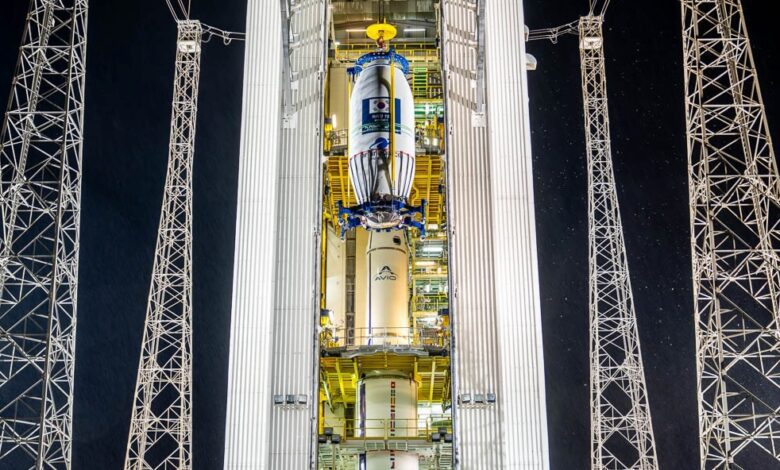
Today, the global space industry is focused on French Guiana, where the European Vega C rocket is set to launch from the Kourou Space Center. Onboard is the South Korean satellite KOMPSAT-7, designed to take Earth surface observation to a new level. The launch is scheduled for 12:21 PM US Eastern Time (17:21 GMT, 14:21 local time in Kourou). The event is expected to be broadcast live, allowing millions of viewers around the world to witness this technological milestone.
The spacecraft, weighing nearly 1.8 tons, was developed by experts at the Korea Aerospace Research Institute. KOMPSAT-7 continues a satellite series that began with the launch of KOMPSAT-3A in 2015 and aims to meet the growing demand for detailed images of the Korean Peninsula. According to Arianespace, the company responsible for the launch, the new satellite will be one of the world’s most advanced optical high-resolution satellites.
The key feature of KOMPSAT-7 is its innovative data transmission system, used for the first time on a Korean satellite. Utilizing optical channels and advanced processing modules, the satellite can transmit and analyze vast amounts of imagery in real time. This opens up new possibilities for monitoring natural phenomena, urbanization, and addressing national security challenges.
Technologies and objectives
The development of Vega C was carried out under the auspices of the European Space Agency. This four-stage medium-lift rocket has already established itself on the international launch market. Of its five previous missions, four have been successful, with the only failure occurring in December 2022 during its second flight.
Today’s launch, designated VV28, will be the sixth in the history of Vega C. If all goes according to plan, 44 minutes after liftoff the satellite will reach a sun-synchronous orbit at an altitude of 576 kilometers. This type of orbit allows the spacecraft to pass over the same areas of the planet at the same solar time each day, which is particularly important for obtaining comparable images and analyzing changes on Earth’s surface.
The new satellite’s capabilities will allow South Korea not only to improve the quality of its own geospatial data, but also to offer services to other countries and companies. KOMPSAT-7 can capture the smallest details, making it an indispensable tool for mapping, agriculture, emergency response, and environmental monitoring.
International cooperation
The launch of KOMPSAT-7 is the result of close collaboration between European and Asian experts. The French company Arianespace, with its extensive experience in commercial launches, ensures the reliable delivery of the satellite into orbit. For South Korea, this is not only a technological achievement but also a high-profile project, highlighting its growing ambitions in the space sector.
In recent years, East Asian countries have been actively investing in the development of their own satellite programs. South Korea, alongside Japan and China, is striving to take a leading position in the field of Earth remote sensing. KOMPSAT-7 is an important step in this direction, allowing the country to strengthen its presence in the global space services market.
The European Vega C rocket, meanwhile, reaffirms its reputation as a reliable launch vehicle for placing satellites of various kinds into orbit. The successful completion of the VV28 mission will provide further incentive for continued cooperation between European and Asian companies in the space industry.
The future of observation
With each new launch, remote sensing technologies are becoming ever more advanced. KOMPSAT-7 is a vivid example of how modern satellites are capable not only of capturing events on the planet’s surface, but also of instantly transmitting and processing the data received. This is especially vital for prompt response to natural disasters, monitoring climate change, and tracking the state of the environment.
In the coming years, new satellites with even more advanced capabilities are expected to emerge. However, the launch of KOMPSAT-7 already opens up new horizons for researchers and data analysts today. The ability to receive real-time images significantly expands the range of tasks that can be accomplished using satellite technology.
For South Korea, this project represents not only a technological achievement but also a crucial part of its national strategy to develop high-tech industries. Amid growing competition in the global space services market, such missions are key to strengthening the country’s position.
If you weren’t aware, Arianespace is a leading European launch services provider, founded in France in 1980. Over the decades, it has placed hundreds of satellites into orbit for clients around the world, using rockets from the Ariane, Vega, and Soyuz families. Vega C is one of the company’s latest developments, designed to launch medium and small spacecraft into orbit. The Korea Aerospace Research Institute (KARI) is responsible for developing and operating the KOMPSAT satellite series, which are used for scientific, commercial, and government purposes.