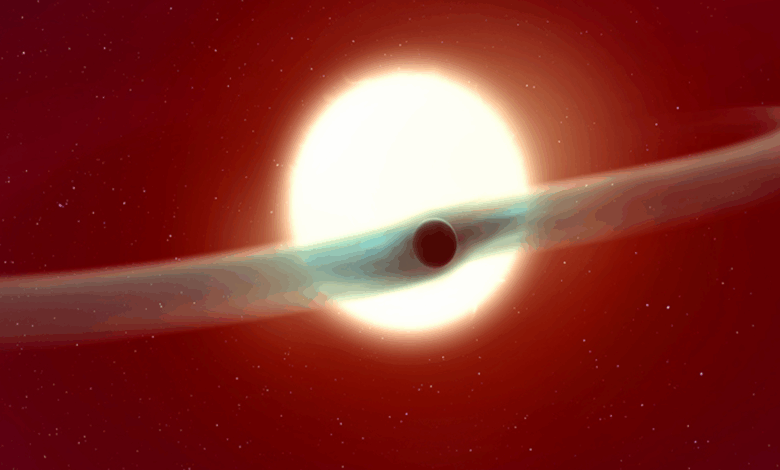
Using the James Webb Space Telescope, an international team of astronomers has discovered two extensive streams of helium gas emanating from the exoplanet WASP-121b. This discovery has caused quite a sensation, as such a phenomenon does not fit within existing scientific models. WASP-121b, located about 858 light-years from Earth, belongs to the class of so-called “ultra-hot Jupiters”—massive gas giants orbiting in close proximity to their stars.
The planet completes a full orbit around its star in just 30 hours. Because of this close proximity to its parent star, the atmosphere of WASP-121b heats up to extreme temperatures—about 2,300 degrees Celsius. Under intense radiation, light elements such as hydrogen and helium begin to escape the planet, forming distinctive gas tails trailing off into space.
Until now, scientists have only been able to observe atmospheric escape during exoplanet transits—when the planets pass in front of their stars. However, such observations provided only a fragmented picture, making it impossible to determine whether the escape process continues outside these brief intervals.
New horizons
Using the NIRSpec spectrograph aboard James Webb, researchers were able for the first time to track the behavior of helium for almost 37 hours—nearly the entire orbit of WASP-121b. This provided the most comprehensive view yet of how atmospheric escape occurs on planets of this type.
The results were unexpected: the helium signal was detected for more than half of the orbital period, marking the longest continuous recording of this phenomenon in observational history. It turned out that the gas cloud surrounding WASP-121b extends far beyond the planet itself, and its structure is much more complex than previously thought.
What was particularly surprising was that the helium forms not one but two distinct tails. One trails behind the planet’s motion under the influence of stellar wind and radiation, while the other extends forward, seemingly drawn by the star’s gravity. Current theories cannot yet explain why these gas streams behave in such an unusual way.
A challenge for science
The length of these tails is astonishing: they are a hundred times the diameter of WASP-121b itself and three times the distance between the planet and its star. Such a configuration has never been seen in any known model of atmospheric processes on exoplanets.
According to the researchers, the new data force a reassessment of how the atmospheres of hot gas giants form and evolve. Scientists now face the task of finding new physical mechanisms that can explain such unusual helium behavior.
Helium is considered one of the key indicators of atmospheric escape on exoplanets. Thanks to the high sensitivity of the James Webb, astronomers can track it even at vast distances. By analyzing how helium absorbs light, researchers were able to create a detailed picture of the gas distribution around WASP-121b.
Planet under the spotlight
WASP-121b, also known as Tylos, has long attracted the attention of experts due to its extreme conditions. Its atmosphere is constantly exposed to intense radiation, leading to gradual mass loss. Such processes can strongly impact planetary evolution and may even determine their ultimate fate.
Previously, scientists could only speculate about how intense atmospheric escape is in hot Jupiters. Now, thanks to new observations, it has become clear that this process can be much more complex and extensive than previously thought. The dual helium tails phenomenon calls for a reevaluation of many established ideas.
The study, published in one of the leading scientific journals, has already sparked lively debate in the astronomical community. Specialists note that such discoveries are opening new horizons for studying exoplanets and their atmospheres.
The future of research
In the coming years, scientists plan to continue observing WASP-121b and other hot Jupiters to determine how common such phenomena are. It’s possible that double gas tails are not unique to this planet, but a typical feature of an entire class of exoplanets.
James Webb has already proven its effectiveness in studying distant worlds. Its instruments provide data with unprecedented precision, offering a chance to uncover even more mysteries of the Universe. New discoveries could not only change our understanding of planets beyond the Solar System, but also help us comprehend the processes taking place in the early stages of planet formation.
If you didn’t know, the James Webb Space Telescope is the largest and most advanced space telescope, launched in 2021. It was developed by an international consortium involving NASA, ESA, and the Canadian Space Agency. The main mission of the telescope is to study the early Universe, exoplanets, and the processes of star formation. Thanks to its unique instruments, James Webb can detect infrared radiation, allowing it to peer into the most distant corners of space and discover previously unobservable objects.