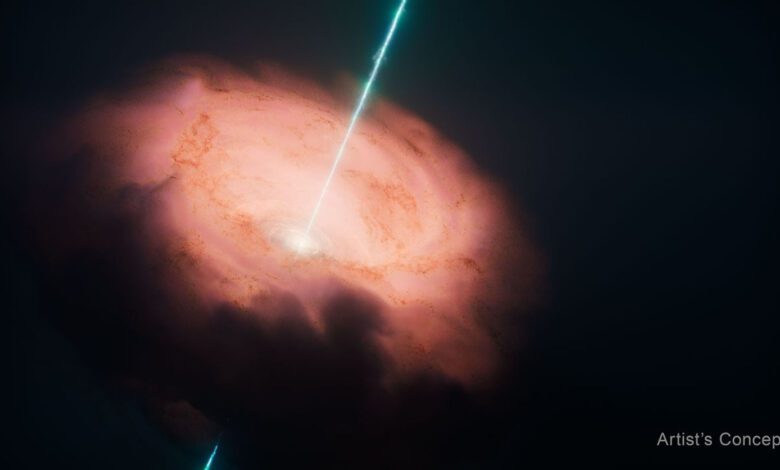
In January 2026, the astronomical community was swept up in a sensation: the James Webb Space Telescope (JWST) delivered the most detailed images yet of the region surrounding the supermassive black hole in the Circinus galaxy. Not only did these images impress with their clarity, but they also challenged previous views on the nature of infrared emission in active galaxies. It turned out that the main source of this emission was not powerful outflows as previously thought, but rather a dense dust disk feeding the black hole.
Located about 14 million light-years from Earth, the Circinus galaxy has long fascinated scientists. But only now, thanks to the unique capabilities of JWST, have researchers been able to examine its core with unprecedented detail. Under the leadership of Enrique López-Rodríguez from the University of South Carolina, the team applied innovative observation techniques to peer through thick clouds of dust and gas that obscure the galaxy’s central region.
Two observation sessions, held in July 2024 and March 2025, made it possible to collect light using a special aperture consisting of seven tiny hexagonal holes. This design creates distinctive interference patterns that help separate the emission from hot dust from other sources and map the finest structures at the very heart of the galaxy.
Dust and light
The results were striking: about 87% of the infrared radiation originates from the region immediately surrounding the black hole. Here, dust and gas form a flattened disk aligned with the galaxy’s equatorial plane. This disk acts as the main reservoir of matter, gradually feeding the black hole and sustaining its growth and activity.
Less than 1% of the radiation is associated with the mysterious arc-shaped structure known as the North Arc. In this zone, hot dust is driven outward by powerful outflows from the black hole. The remaining 12% comes from more distant areas, where dust is heated by the black hole’s radiation and a weak radio jet, but is no longer involved in the accretion process.
Such a level of detail became possible only thanks to the telescope’s unique design. As one of the study’s participants, Joel Sánchez-Bermúdez of the National Autonomous University of Mexico, pointed out, the new method enabled images twice as sharp as usual. “It’s as if we were observing this region not with a 6.5-meter mirror but with a 13-meter space telescope,” he emphasized.
A Paradigm Shift
For many years, astronomers believed that the excess infrared radiation near active black holes was mainly due to dust streams being expelled outward. However, new JWST data completely disproves this hypothesis. It turns out that it is the inner disk, not the external outflows, that shapes the energy profile of a galaxy’s core.
This misconception stemmed from the limitations of previous telescopes: their resolution was insufficient to distinguish individual components such as the accretion disk, dust torus, and outflows. All of these appeared as a single indistinct spot. Now, with the core ‘unpacked’ into its elements, it has become clear that earlier models need serious revision.
Understanding exactly how black holes accumulate mass and impact the evolution of galaxies is crucial for modern astrophysics. Accretion and feedback processes can both suppress and stimulate star formation, shaping galaxies for billions of years to come.
Looking Forward
The discovery made in Circinus may prove universal for most active galaxies in the universe. Researchers are already planning to apply this new approach to other nearby black holes to gather data and determine how typical this structure really is.
According to López-Rodríguez, a comprehensive analysis will require studying at least a dozen, preferably two dozen, similar objects. Only then will it be possible to understand the relationship between the mass in accretion disks and the power of the outflows, as well as how these parameters influence the evolution of galaxies as a whole.
In the coming years, astronomers face a true race for new discoveries. Every new image captured by JWST has the potential to upend established views on the nature of black holes and their role in cosmic history.
Technology and challenges
The technical aspects of JWST’s operations are as impressive as its scientific results. The use of complex aperture masks and interferometric techniques has achieved a resolution previously thought unattainable for infrared telescopes. This paves the way for studying even the most hidden and dust-shrouded regions of the Universe.
However, these new capabilities also pose fresh challenges for scientists. Now, dozens if not hundreds of previous observations must be re-examined to separate real physical processes from artifacts caused by limited resolution. Years of painstaking work lie ahead, but so does the chance for breakthroughs that until recently seemed like science fiction.
In case you didn’t know, the James Webb Space Telescope is the largest and most advanced infrared telescope in history, launched in 2021 through a collaboration between NASA, ESA, and the Canadian Space Agency. Its primary mission is to study the early Universe, the formation of galaxies, stars, and planetary systems, as well as to analyze exoplanets and their atmospheres. Thanks to its unique design and its orbit at the Lagrange point L2, JWST can observe the most distant and faintest objects unreachable by other instruments. Over its years of operation, the telescope has already made a series of groundbreaking discoveries that have reshaped our understanding of the cosmos.