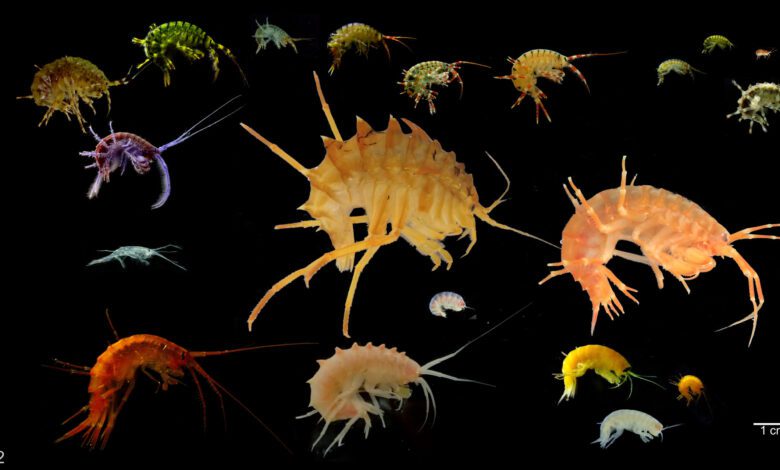
Deep within Lake Baikal lives a unique community of amphipod crustaceans, comprising more than three hundred species. Among them are so-called cryptic species—organisms that are virtually indistinguishable in appearance, yet genetically represent distinct evolutionary lineages. These differences are so profound that individuals from different species can no longer produce viable offspring. This process is called reproductive isolation, and it plays a key role in shaping the biodiversity of Baikal.
Research conducted at the Research Institute of Biology of Irkutsk State University has revealed that the amphipod species Eulimnogammarus verrucosus, previously thought to be a single species, actually consists of at least three distinct species. Their evolutionary paths diverged millions of years ago, and attempts to cross individuals from opposite shores of the Angara river source resulted in nonviable hybrids. This confirmed that even in the absence of external differences, the genetic barriers between them are already insurmountable.
In new experiments, scientists expanded the scope of their research to include three types of the Eulimnogammarus verrucosus complex. Special attention was given to the behavior of amphipods during the breeding season, particularly when they encountered closely related species. It turned out that, when given a choice, these animals almost always prefer partners from their own species. However, if there is no alternative, they attempt to mate with their closest relatives, but in such cases, embryonic development halts at an early stage.
Genetic Barriers and Species Evolution
The key moment comes when embryo development has to switch from relying on maternal resources to being governed by its own genome. It is at this stage that hybrid embryos stop developing, showing a profound genetic incompatibility. Over millions of years of independent evolution, each species has accumulated unique mutations that now prevent them from exchanging genetic material.
Interestingly, in some cases where no mating occurred at all, smaller individuals would disappear from the aquariums. This may indicate aggression between members of different species—an additional factor maintaining species boundaries. According to experts, this behavior is one of the mechanisms preventing the merging of species back together.
Practical Significance of the Research
According to Maxim Timofeev, Director of the ISU Institute of Biology, studying cryptic species is valuable not only in theory but also in practice. The genetic differences found in marker genes are just the tip of the iceberg. Behind them lie important adaptive traits, including varying resilience to adverse environmental conditions. This knowledge can be used to predict the behavior and evolution of rare species that are difficult to study under laboratory conditions.
The team now plans to move on to experiments with species displaying intermediate genetic diversity. The aim is to determine the threshold at which complete reproductive isolation occurs. These findings will help shed light on the mechanisms of speciation, not only in Baikal amphipods but also in other organisms inhabiting unique ecosystems.
Experiments and New Discoveries
The results of the latest research were published in the international scientific journal Diversity. The authors note that their work was supported by a Russian Science Foundation grant, which enabled large-scale experiments and produced new insights into the behavior and biology of Baikal amphipods. In particular, the study revealed that even with outward similarities, different species show varying sensitivity to environmental conditions and react differently to stress factors.
These discoveries open up new opportunities for studying evolutionary processes in enclosed bodies of water like Lake Baikal. Understanding the mechanisms of reproductive isolation and speciation can be valuable for biodiversity conservation and for developing strategies to protect unique ecosystems.
By the way: Irkutsk State University and its contribution to science
Irkutsk State University (ISU) is one of the oldest universities in Eastern Siberia, founded in 1918. The Scientific Research Institute of Biology at ISU is well known for its work in ecology, hydrobiology, and molecular biology. The institute’s scientists regularly conduct studies focusing on the unique flora and fauna of Lake Baikal, as well as issues related to preserving the lake’s ecosystem. Under the leadership of Dr. Maxim Timofeev and PhD Polina Drozdova, the institute’s team has made significant advances in research on the genetic diversity and evolution of Baikal’s organisms. Their work is highly regarded both in Russia and internationally. With support from the Russian Science Foundation and other grant programs, ISU remains one of the leading research centers studying Baikal and its inhabitants.