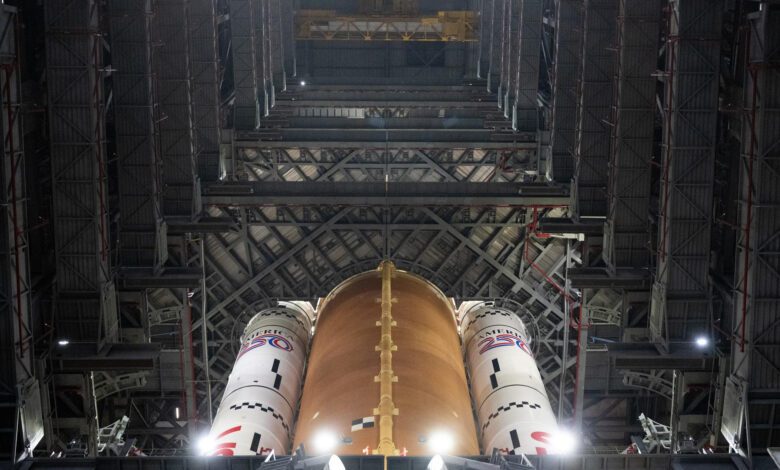
In early 2026, the space industry is once again holding its breath as NASA announces its readiness to roll out the massive Space Launch System (SLS) rocket with the Orion spacecraft for the Artemis 2 mission. This event promises to be one of the most significant moments in modern space exploration. For the first time in half a century, a four-person crew will travel to the Moon for a ten-day flight around Earth’s satellite before returning home. Preparations for the launch are in full swing, and on January 17, unless affected by weather or technical issues, SLS and Orion are set to begin their journey to Launch Pad 39B at Cape Canaveral.
Transporting this colossal rocket is a spectacle in itself. The specialized Crawler-Transporter 2 will slowly but steadily cover the four-mile distance from the assembly facility to the launch complex. The process will take up to twelve hours, with every meter closely monitored by engineers and specialists. NASA emphasizes that crew safety is the absolute priority, and not a single detail will be overlooked.
Crew and route
The crew includes three NASA astronauts—Reid Wiseman, Victor Glover, and Christina Koch—as well as Canadian Space Agency representative Jeremy Hansen. Their mission is not to land on the lunar surface, but to fly around the Moon and return to Earth, ushering in a new era of crewed missions beyond low Earth orbit. The last time such a journey was made was in December 1972 when Apollo 17 concluded America’s lunar program.
After arriving at the launch pad, engineers will conduct a series of tests and inspections. The key stage will be the so-called “wet dress rehearsal”—filling the rocket with more than 700,000 gallons of cryogenic propellants and practicing all countdown procedures. At that moment, there will be no crew members at the site—only equipment and specialists prepared for any contingencies.
Testing and risks
Such tests rarely go without surprises. During preparations for the Artemis 1 mission, engineers encountered liquid hydrogen leaks, which forced the rocket to be returned to the assembly building several times to fix the issues. The launch was delayed by almost six months, but ultimately, the mission was a success: the uncrewed Orion circled the Moon and returned to Earth, proving the entire system’s reliability.
Now at stake is the first crewed flight. After completing all tests, the team will conduct a final readiness review before announcing the exact launch date. The launch window is limited: between February 6 and April 10, 2026, there are only 15 possible days to send the crew to the Moon.
Launch schedule
NASA has divided the possible launch dates into three windows. The first window, from January 31 to February 14, offers five potential days: February 6, 7, 8, 10, and 11. The second window, from February 28 to March 1, includes March 6, 7, 8, 9, and 11. The third, from March 27 to April 10, provides five more opportunities: April 1, 3, 4, 5, and 6. However, even on these days, a launch is not guaranteed: much depends on weather conditions, technical readiness, and the schedule of other launches on the US East Coast.
NASA emphasizes that no more than four launch attempts can be made within a single week. Every launch requires thorough preparation, and any deviation from the plan can lead to further delays. Still, the space industry is long accustomed to such risks—here, ambition and reality must always be carefully balanced.
Challenges and Expectations
This time, a lot is at stake. Artemis 2 is not just another mission; it is a symbol of humanity’s return to deep space exploration. The success or failure of this flight will determine the future of the entire Artemis program, including plans to build a lunar base and prepare for expeditions to Mars. Yet even if things do not go according to plan, the experience and knowledge gained during the preparation and testing phases will be invaluable for future generations of explorers.
As the countdown continues, millions around the world are following NASA’s every move. The intrigue remains until the very end: will the team overcome all obstacles and turn the page on a new era in space exploration? We’ll have the answer very soon.