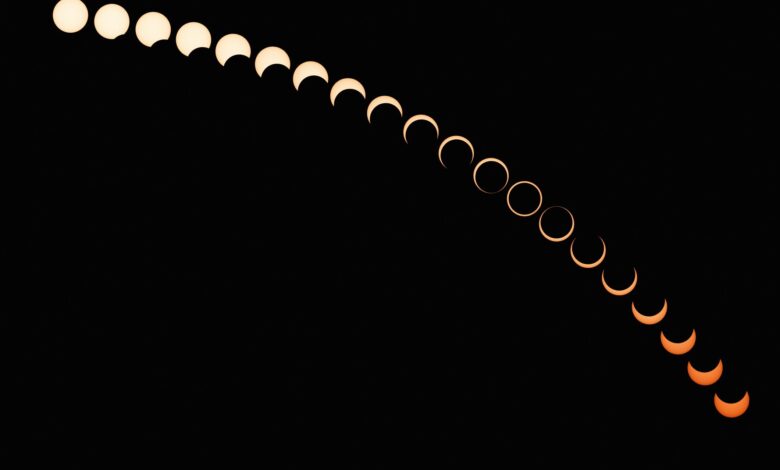
The solar eclipse set to occur on February 17, 2026, is already being called one of the most significant events of the year for residents of the Southern Hemisphere. On this day, a rare astronomical phenomenon—an annular eclipse—will unfold over Antarctica and nearby regions, when the Moon will not completely cover the Sun, leaving a bright ring of light around it. Observers in Patagonia, Southern Africa, and Madagascar will see a partial eclipse, but even this glimpse of the cosmic spectacle is likely to spark discussions and anticipation.
Astrologers and astronomers agree: phenomena like this impress not only visually but also influence people’s emotional states. This time, the eclipse coincides with the start of the Chinese Year of the Fire Horse, adding extra symbolism to the event. Many note that on such days, there is a drop in energy, a desire to reconsider decisions, and a new perspective on familiar things. It is possible that this February day will become a starting point for changes that will affect not just individual destinies, but entire communities.
Impact on decisions
The peculiarity of this eclipse is that it occurs in the sign of Aquarius, which, according to astrologers, amplifies the desire for freedom, independence, and the search for new directions. In the days following the eclipse, many will feel an inner push to analyze their actions and plans. However, experts advise against rushing into important decisions: the eclipse’s influence may blur one’s perception of reality and heighten emotions. This is a time better suited for observation, reflection, and searching for hidden meanings in current events.
The influence of the eclipse can manifest in a variety of areas, from personal relationships to professional matters. Don’t be surprised if familiar patterns of behavior suddenly stop working or old plans seem irrelevant. In such moments, it’s important to stay calm and not give in to impulsive urges. Only a few days after the eclipse will it become clear which changes are truly necessary and which were just illusions.
Astronomical Details
From a scientific standpoint, a solar eclipse is the result of the perfect alignment of the Moon and the Sun, when Earth’s satellite completely or partially covers the star. During an annular eclipse, the Moon is at its greatest distance from Earth and thus cannot entirely block the Sun, leaving a bright “ring of fire” around the edges. Special protective glasses are required to observe this phenomenon safely, otherwise serious eye damage can occur.
In 2026, this is the first of four expected eclipses, which traditionally occur in pairs: a solar and a lunar eclipse, separated by about two weeks. The next one, a lunar eclipse, will take place on March 3, but it won’t be visible from Spain. Such periods are called ‘eclipse seasons,’ and they always generate heightened interest among both scientists and the general public.
Psychological effect
Many note that the days surrounding an eclipse become a time for reflection and searching for new direction. The influence of Aquarius may make people more critical, independent, and even prone to rebelling against established norms. This isn’t always easy, as the sense of freedom can also bring uncertainty: familiar anchors may seem unstable, and the future—uncertain. At such times, it’s important not to rush to conclusions and give yourself time to adapt.
Astrologers warn: eclipses are rarely a good time to sign contracts, start new relationships, or make abrupt career changes. It’s better to use this period to observe yourself and those around you, to understand which changes are truly necessary, and which are best postponed until calmer times.
Solar eclipses have always inspired awe and admiration. In different eras, they were seen as harbingers of change, and at times even of catastrophe. Today, even though science has explained the nature of this phenomenon, it has not lost its magic. For many, February 17, 2026, will be a day remembered not only for its extraordinary spectacle in the sky, but also for personal discoveries within.
In astrology, Aquarius symbolizes the pursuit of freedom, innovation, and collective goals. Eclipses in this sign often serve as catalysts for changes that affect not only individuals, but entire communities. In 2026, this event carries special weight, as the previous eclipse in Aquarius happened almost eight years ago. For many, this is a chance to reevaluate priorities, find new meaning, and move beyond the familiar.
Solar eclipses are among the most spectacular phenomena visible from Earth. They occur only during a new moon, when the Moon passes along the line between the Earth and the Sun. Depending on the distance between these celestial bodies, eclipses can be total, annular, or partial. Each type of eclipse is unique in its own way and requires special conditions for observation.
In 2026, the annular eclipse will be not only an astronomical event but also a reason to reflect on the future. The impact of this phenomenon on emotional states and decision-making becomes especially pronounced when it coincides with the start of a new astrological cycle. For many, this day will mark a starting point for changes that will be discussed for a long time in various circles.
In astrological tradition, Aquarius is considered a sign of reformers, dreamers, and those unafraid to go against the current. Eclipses in this sign often bring a time of unexpected discoveries and bold decisions. In 2026, the annular eclipse in Aquarius promises to be just such a moment—a time when familiar rules no longer apply and new ideas and a drive for freedom come to the forefront.
The solar eclipse of February 17, 2026 is not just a rare astronomical event, but also a symbol of change that could affect everyone. On this day, it is especially important to pay attention to your feelings, thoughts, and actions, as they could determine the direction of future events.
Aquarius is one of the most mysterious and contradictory signs of the zodiac. Its influence is linked with change, the search for new paths, and a quest for freedom. Eclipses in this sign have always attracted the attention of astrologers and fans of extraordinary phenomena. In 2026, the annular eclipse in Aquarius promises to be a memorable event, not only due to its rarity but also because of the changes it may bring into everyone’s life.