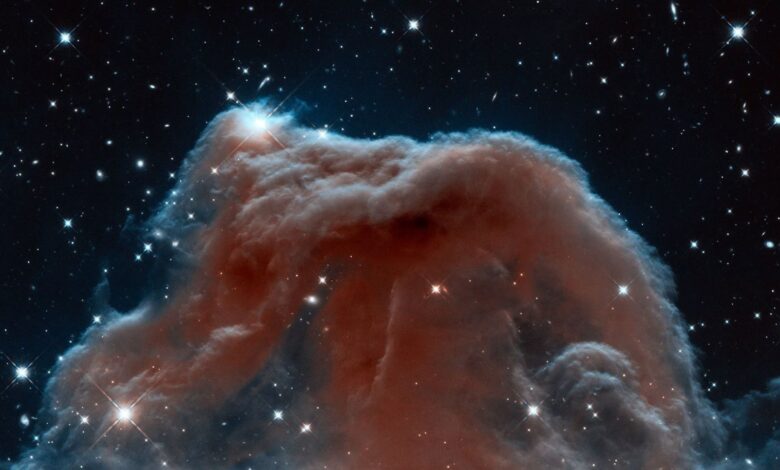
In recent years, astronomers and chemists have increasingly focused on the role of cosmic dust in the formation of complex molecules that could become building blocks for life. A new study by an international team of scientists sheds light on how tiny particles scattered throughout interstellar clouds provide a stage for unique chemical processes. Experiments conducted at the Friedrich Schiller University Jena have shown that it is the porous structure of dust that allows molecules to meet and interact in reactions leading to the creation of so-called ‘bricks of life.’
Until recently, it was believed that cosmic dust was covered with a dense icy shell, isolating its surface and preventing chemical interactions. However, modern observations and simulations suggest the opposite: even with icy layers present, the surface of the dust grains remains accessible for reactions. This discovery is changing our understanding of interstellar chemistry and how the first organic compounds could have formed.
Porous dust—a perfect laboratory for molecules
In the experiment, scientists recreated conditions closely resembling those found in interstellar clouds and protoplanetary disks. They used thin layers of carbon dioxide and ammonia, with a layer of porous silicate particles—an analogue of cosmic dust—in between. For comparison, samples without dust and with an icy layer were also prepared. All samples were cooled to extremely low temperatures and then gradually heated, simulating the processes that occur in space.
The results were clear: ammonium carbamate—a compound considered a precursor of urea and other life-essential molecules—formed only in the presence of dust. No such reactions occurred in dustless samples or those with an icy layer. This demonstrates that the porous surface of dust plays a crucial role in triggering complex chemical processes.
Catalyst of Life: A New Role for Cosmic Dust
According to the study’s lead author, physicist Alexey Potapov from the University of Jena, dust particles in interstellar clouds and protoplanetary disks act as microscopic reactors. On their surfaces, molecules collide, combine, and form new structures that can drive the evolution of organic matter. This discovery highlights that dust is not just a passive component of the cosmic environment, but an active participant in the formation of complex compounds.
Scientists plan to continue experiments to determine what other molecules can be synthesized on the surface of cosmic dust. Special attention will be given to protoplanetary disks where new planets are formed. It is possible that traces of chemical reactions similar to those reproduced in the laboratory may be found there.
Looking Ahead: New Horizons in Astrochemistry
The discovery of the role of cosmic dust in the synthesis of organic molecules opens up new prospects for the search for life beyond Earth. If such processes are widespread throughout the galaxy, the likelihood of life emerging on other planets increases significantly. Furthermore, the results of this study could help develop new methods for detecting organics on comets, asteroids, and in exoplanet atmospheres.
In the coming years, scientists intend to use data from modern telescopes and space missions to seek confirmation of the laboratory results in real conditions. Of particular interest are regions where active star and planet formation is taking place — as these have the highest concentrations of dust and complex molecules.
By the way, regarding Friedrich Schiller University Jena
The Friedrich Schiller University of Jena (Friedrich-Schiller-Universität Jena) is one of Germany’s oldest and most prestigious universities, founded in 1558. The university is renowned for its achievements in the natural sciences, particularly physics, chemistry, and astronomy. It employs some of Europe’s leading experts, and its laboratories are equipped with cutting-edge technology for conducting highly complex experiments. Throughout its history, the university has produced numerous outstanding scientists, including Nobel laureates. In recent years, the University of Jena has been actively involved in international scientific projects related to space and astrochemistry research. It is here that a unique laboratory was established for experiments simulating interstellar conditions. These research efforts have strengthened the university’s reputation as one of the leading centers of advanced science in Europe.