Stellar Mass Limits and the Mysteries of Cosmic Evolution
For a long time, astronomers believed that stars have a mass limit—about 120 times the mass of our Sun. Exceeding this threshold would trigger internal processes that destroy the star. This principle has been the foundation for all modern models of galaxy formation, including our Milky Way. However, recent studies show that this rule does not always apply, especially under the unusual conditions of the early Universe.
In typical stars, radiation prevents matter from accumulating, causing mass loss. This naturally limits their growth. But if the surrounding environment is poor in heavy elements or if gas flows in at an exceptionally high rate, objects can form that far exceed the usual size limits.
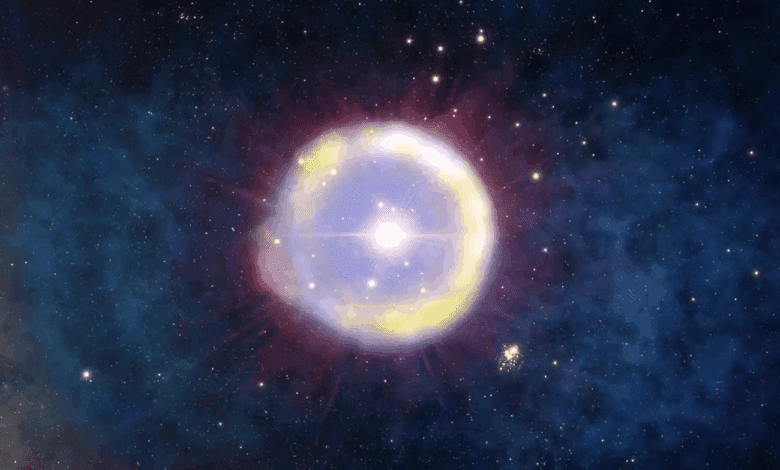
Of particular interest are the so-called Population III stars—the first celestial bodies that appeared from hydrogen and helium shortly after the Big Bang. These stars had almost no heavy elements, allowing exceptionally massive structures to develop. According to calculations, the mass of such stars could reach thousands of times that of the Sun.
Searching for Ancient Giants and the Role of the James Webb Telescope
Until now, the existence of supermassive Population III stars was purely theoretical. These objects had not been directly observed, and researchers searched for their possible traces through indirect signs—such as unusual chemical signatures in ancient galaxies. It is believed that these stars emerged 100–400 million years after the Big Bang and quickly vanished, giving way to new generations of stars.
One of the main mysteries of the early Universe remains the supermassive black holes, which had already reached enormous sizes just 500–700 million years after the Big Bang. Ordinary growth processes cannot explain such rapid mass accumulation. Scientists have long tried to figure out how these objects could have formed so early.
The situation changed with the launch of the James Webb Space Telescope. Its infrared instruments made it possible to discover numerous distant galaxies and examine their chemical makeup. Of particular interest was the galaxy GS 3073, located 12.7 billion light-years from Earth.
Anomalous Nitrogen and the Hypothesis of Supermassive Stars
An international team of astrophysicists led by Devesh Nandal from the Harvard-Smithsonian Center for Astrophysics discovered an unusually high concentration of nitrogen in the spectrum of GS 3073. Previously, such chemical signatures were linked to supernova explosions or the activity of Wolf–Rayet stars, but in this case, the nitrogen level proved far too high for standard scenarios.
Ordinary stars produce nitrogen slowly and in limited amounts. Even supernova explosions don’t generate as much nitrogen as was detected in GS 3073. This suggests the existence of a powerful source capable of saturating a galaxy with this element in a short period of time.
Since the first stars formed from hydrogen and helium, the appearance of large quantities of nitrogen in such an ancient galaxy may indicate that intense thermonuclear reactions took place within these giants. Researchers calculated that just a few stars with masses between 1,000 and 10,000 solar masses would be enough to explain the observed excess nitrogen.
Debates within the scientific community and new horizons
Not all scientists agree with this interpretation. Some experts point out that Population III stars should form in environments almost devoid of heavy elements, whereas GS 3073 already contains a significant amount of ‘metals.’ This casts doubt on whether the universe’s first giant stars could have existed in this galaxy.
Nevertheless, many researchers believe that the analysis of GS 3073 opens new possibilities for understanding processes that took place in the early universe. The first galaxies may have differed from modern ones in their physical properties, and studying their chemical composition brings us closer to uncovering the origins of supermassive black holes.
If the hypothesis about the existence of Population III giant stars is confirmed, this could explain how black holes billions of times more massive than the sun could have formed in such a short time. Such objects may have emerged directly from the collapse of supermassive stars, bypassing the prolonged stage of accumulating mass through accretion.
Significance of the discovery and prospects for future research
The discovery of unusual chemical signatures in GS 3073 could be the key to understanding the early stages of galactic evolution. If the existence of supermassive stars is confirmed, it will change our view of the formation of the universe’s structure and the origins of the most massive black holes.
Further observations with modern telescopes will help clarify the details of this process and may reveal new examples of similar galaxies. Astrophysicists continue to analyze the data to determine how common such phenomena are and how they influenced the development of the cosmos.
In the coming years, new instruments are expected to appear that will allow us to peer even deeper into the universe’s past and find further evidence of giant stars existing in the first hundreds of millions of years after the Big Bang.
If this hypothesis is confirmed, it would be one of the most significant discoveries in modern astronomy, capable of transforming our understanding of the origin and evolution of galaxies.
As a reminder, the James Webb Space Telescope (JWST) is the largest and most advanced orbital observatory, launched in December 2021 through a joint effort by NASA, the European Space Agency (ESA), and the Canadian Space Agency (CSA). The telescope was designed to observe the most distant and ancient objects in the Universe and to study the processes of star and galaxy formation. Thanks to its unique infrared instruments, JWST can capture light from the earliest epochs of the cosmos, allowing scientists to gather data on events that occurred just a few hundred million years after the Big Bang. The telescope has already made several significant discoveries, including the detection of ancient galaxies and the analysis of their chemical composition. Its mission is planned for at least 10 years, during which JWST is expected to greatly expand our understanding of the structure and history of the Universe. Leading scientific centers from around the world are involved in the project, and the data collected are available to researchers from different countries. JWST is regarded as the successor to the renowned Hubble Telescope and is opening new horizons for astronomy and astrophysics.