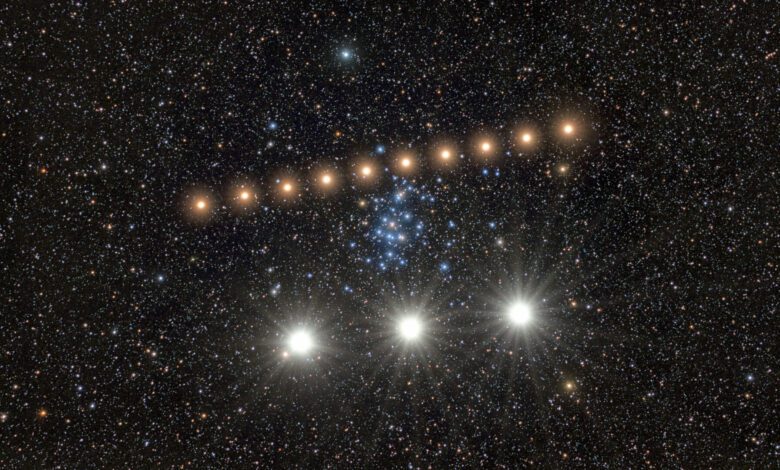
A truly unique astronomical spectacle unfolded in the skies over the Southern Hemisphere: two bright planets, Venus and Mars, crossed one of the most famous star clusters—M44, also known as The Beehive or Praesepe—as if following a script. In a rare composite image created by Czech astrophotographer Petr Horálek, the planets can be seen leaving two glowing dotted trails against the dense star field. This isn’t just a beautiful photograph—it’s visual proof of how planets “wander” among the stars, a vivid reminder of the ancient origin of the word “planet.”
Creating this image took weeks of observation and patience. Mars began its journey through the cluster in late April 2025 and completed it in early May. Venus appeared in this part of the sky only at the end of August, just as dawn began to paint the horizon, and its crossing lasted only a few brief morning hours. Both planets traveled their orbits, and only thanks to a fortunate alignment did their paths pass against the same star cluster within the same year.
Celestial Paths
The images used in the final composition were taken in several countries: Chile, Bolivia, and the Czech Republic. Each shot captured the nighttime position of the planet in relation to the Beehive Cluster, and then all the images were combined into a single picture. In the resulting photograph, two trails are clearly visible — the upper one belongs to Mars, the lower to Venus. Between them stretches the cluster itself, consisting of about a thousand stars located some 600 light-years from Earth in the constellation Cancer.
M44 is a favorite target for skywatchers. It’s one of the closest and richest open clusters visible to the naked eye. When a bright planet passes in front of it, the effect is dramatic: it’s as if a new, moving light appears against a distant scattering of stars. Moments like these are what make astronomy truly captivating.
An illusion of motion
Unlike the stars, planets constantly change their position in the sky. This is evident in such composite images: each night, Venus and Mars appeared at a new spot relative to the cluster. The dashed lines are the result of consecutive photos taken over several nights. This visual technique turns the abstract knowledge of planetary motion into a striking reality that’s impossible to forget.
The Beehive Cluster is located quite close to the ecliptic—the imaginary plane along which the planets of the Solar System orbit. As a result, they occasionally appear to pass in front of it. However, having two bright planets simultaneously in this part of the sky within a single year is an extremely rare event. It serves as a reminder that, even within the familiar cosmic order, remarkable coincidences can still occur.
Astronomy for Everyone
Events like this delight not only professional astronomers but also inspire amateurs around the world. To see planets against the backdrop of a star cluster, you don’t need advanced equipment—just a clear sky and patience. Such occasions bring people together for gatherings, discussions, and new discoveries. Photos like these allow us to see the familiar night sky in an entirely new way.
Venus and Mars, appearing against the background of M44, seemed to remind us that our planetary system isn’t static but alive and brimming with motion. Each year brings new surprises, and even the most experienced observers can’t predict what the next celestial show will hold.
If you didn’t know, Petr Horálek is a prominent Czech astrophotographer and science popularizer, honored with the title of Audiovisual Ambassador by the international organization NOIRLab. His works are regularly featured in leading astronomical publications, and his unique images of the night sky inspire thousands around the world to observe and explore space themselves.