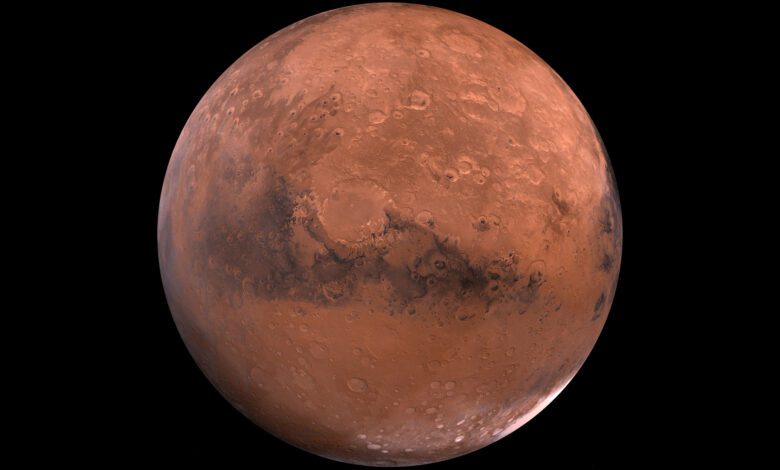
Time on Mars passes a bit differently than on our planet. Each Martian day is about 477 microseconds shorter than an Earth day. The reason lies in the complex laws of physics described by Albert Einstein in his general theory of relativity. For future missions and the development of navigation systems on Mars, this difference could pose a real challenge.
Researchers from the U.S. National Institute of Standards and Technology (NIST) — Neil Ashby and Bijunath Patla — conducted detailed calculations to determine just how differently time progresses on the two planets. They considered not only Mars’ gravity, which is about five times weaker than Earth’s, but also the peculiarities of its orbit, as well as the influence of the Sun, Earth, and Moon.
Gravity and orbit
Mars is farther from the Sun than Earth and its orbit is more elongated. This means the speed of the planet’s movement along its orbit changes throughout the year: when Mars is closer to the Sun, it speeds up, and when it’s farther away, it slows down. These variations affect how fast clocks run on the planet’s surface.
The gravitational field of the Sun and neighboring celestial bodies also plays a role. The weaker the gravity, the faster clocks tick — a phenomenon well known to physicists. On Mars, where gravity is weaker than on Earth, time indeed “runs” a little faster.
The effects of relativity
The general theory of relativity states that the passage of time depends on speed and the strength of the gravitational field. For example, time slows down near massive objects like black holes. On Mars, however, because of its lower mass and greater distance from the Sun, clocks run faster compared to those on Earth.
For a Martian astronaut, a second would feel exactly the same as it does on Earth. But if you compared two synchronized atomic chronometers—one on Mars and one on Earth—after a day, the Martian clock would show slightly more elapsed time. The difference can shift depending on the positions of the planets in their orbits and can reach up to 226 microseconds either way.
Technological challenges
Although the time difference may seem insignificant, it’s critical for modern technology. For example, fifth-generation communication systems require precision down to a tenth of a microsecond. If Martian time acceleration isn’t taken into account, data navigation and synchronization between planets could fail.
In the future, as Mars develops its own satellite networks and navigation systems, scientists will have to factor in these microscopic but essential discrepancies. Only then can uninterrupted communication and data transfer between Earth and Mars be ensured.
First steps toward interplanetary synchronization
Ashby and Patla have previously conducted similar calculations for the Moon. It turned out that lunar clocks run 56 microseconds ahead of Earth clocks each day. Now, scientists believe that understanding these nuances is key to developing global navigation systems for exploring other planets.
While the Martian surface is just beginning to be explored by robots and probes, experts are already laying the groundwork for future technologies. The issue of time synchronization between planets is becoming increasingly important as space programs advance.
In case you didn’t know, the National Institute of Standards and Technology (NIST) is the leading American scientific organization specializing in metrology, standardization, and precision measurements. NIST experts develop time synchronization methods for GPS and other global systems. Neil Ashby and Bijunath Patla are renowned authorities in the physics of time and gravity; their research helped shape our current understanding of how relativity affects the operation of clocks in space.