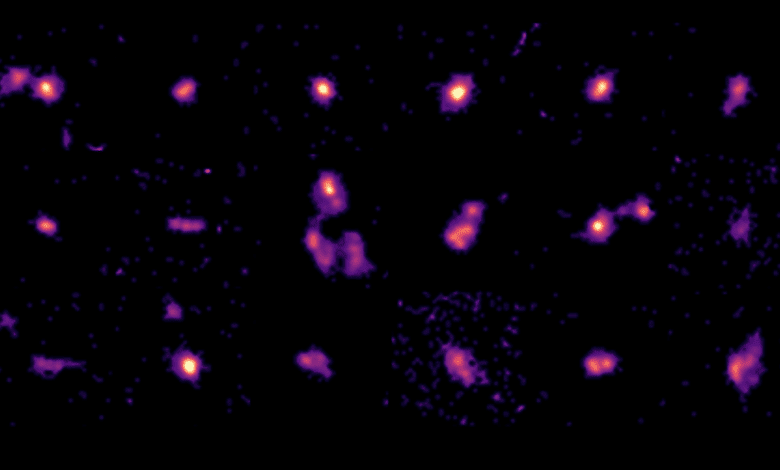
In recent years, astronomers have gained a unique opportunity to peer into the past of the Universe using several cutting-edge tools at once—the James Webb Space Telescope, the renowned Hubble, and the ALMA (Atacama Large Millimeter/submillimeter Array) radio telescope. Thanks to these technologies, scientists have been able to observe young galaxies that existed just a billion years after the Big Bang. It turned out that these cosmic objects evolved at a remarkable pace, far exceeding previous expectations.
The study examined 18 distant galaxies located about 12.5 billion light-years away. These objects can be considered true cosmic “teenagers,” yet even the most experienced experts were astonished by their maturity. At such an early epoch of the Universe, the galaxies were already exhibiting signs of intense star formation and active chemical enrichment.
Unexpected maturity
The most astonishing discovery was that these young galaxies were rich in heavy elements—so-called metals, which astronomers define as anything heavier than hydrogen and helium. Notably, they contained large amounts of carbon and oxygen. Typically, such elements are forged in the cores of stars and released into interstellar space when those stars die, but this process was previously thought to take much longer.
“It’s like a two-year-old suddenly acting like a teenager,” researchers say in amazement. How did such young galaxies manage to accumulate metals so quickly? This question challenges previous models of cosmic evolution and calls for new explanations.
Hungry Black Holes
Another intriguing detail: at the center of many of these galaxies, astronomers have found supermassive black holes actively feeding on surrounding matter. Their growth is as rapid as the formation of new stars. It’s reminiscent of a teenager’s insatiable appetite—only on the scale of entire galaxies.
Such black hole activity may play a key role in the accelerated development of galaxies, influencing star formation and the distribution of heavy elements. However, the exact mechanisms behind this influence remain a matter of debate among scientists.
Structure and Dynamics
In addition to chemical maturity, researchers found that these young galaxies also have complex structures. Many had already developed rotating stellar disks, similar to the spiral arms of the Milky Way. It was previously believed such features formed much later, but new data challenges those assumptions.
Moreover, the surrounding gas — the so-called circumgalactic medium — also turned out to be saturated with metals. In fact, their concentration remained high even at distances of over 30,000 light years from the center of galaxies. This suggests that enrichment processes occurred not only within galaxies themselves, but also in their surroundings.
A Challenge to Existing Theories
These results call into question current theories of galaxy formation and evolution. Previously, it was believed that the accumulation of heavy elements required several billion years, but it is now clear that the universe is capable of surprising us with the speed of its processes.
Scientists plan to compare these new observations with computer models to understand which mechanisms could have led to such rapid galaxy maturation. Special attention is being paid to the interplay between star formation, black hole growth, and the spread of metals.
The Future of Research
The combination of observations and simulations is opening new horizons for researchers. Understanding how the first stars and planets formed will help unlock the mystery of the Milky Way’s origins and those of other galaxies. Every new step in this direction reshapes our view of the universe’s past and future.
RUSSPAIN reminds readers that the James Webb Space Telescope was launched in December 2021 and has become the most powerful tool for studying the early stages of the Universe’s evolution. Its infrared sensors allow scientists to peer through dust and gas, revealing previously unseen details of galaxy and star formation. The telescope is named after James E. Webb, who led NASA during the Apollo program era.