Every year, dozens of oil spill incidents are reported in tropical and subtropical seas. The thin film formed on the surface of the water poses a serious threat to marine ecosystems. It blocks oxygen and sunlight, disrupting the natural life cycle of underwater organisms. This issue is particularly acute in regions with heavy shipping and hydrocarbon extraction, where even a minor accident can lead to an environmental disaster.
Until now, existing methods for cleaning up such pollution have proven largely ineffective in warm seas. Mechanical methods require a significant thickness of oil, while burning is only possible under specific conditions. As a result, most of the thin oil film remained out of reach for rescue services, continuing to harm the environment.
A new formula
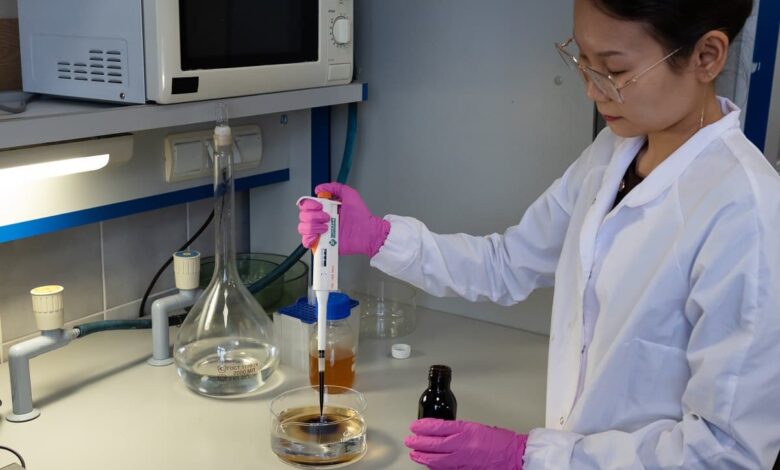
A team of Russian chemists led by academician Alexey Dedov from Gubkin University has developed an innovative reagent that could fundamentally change the situation. The substance, named CH-1, works by “tightening” the oil film, increasing its thickness and reducing the contaminated area by nearly a hundredfold. The formula uses pentol, widely used in pharmaceuticals and cosmetics, as well as isobutanol, which has minimal impact on the environment.
Tests conducted at a research station in Vietnam have shown that the new reagent is able to collect oil slicks into dense clusters, which can then be easily removed mechanically or burned directly on the water’s surface. The thickness of the pollution increases by 11–21 times, making it possible to use standard cleanup methods even for minimal initial oil concentrations.
Application geography
The developed compound is intended for use in seas located between 30 and 40 degrees latitude on both sides of the equator. This includes the eastern part of the Black Sea, the southwestern Caspian, the Mediterranean, the Red Seas, as well as numerous bays, coastal rivers, and lakes. In these regions, it is especially important to use environmentally safe products to avoid aggravating the consequences of accidents with additional chemical exposure.
The reagent is applied around the perimeter of the oil spill, reducing the surface tension of the water. As a result, the contamination contracts, reaching a thickness of up to 3.4 millimeters. This approach allows for effective removal of even the thinnest films, which were previously considered virtually impossible to eliminate.
Testing and prospects
Field tests conducted in Vietnam and on the Black Sea coast near Anapa confirmed that the compound retains its properties for over 24 hours. Rain does not affect the reagent’s effectiveness; however, strong sea waves may complicate the collection process. The optimal conditions are when the sea state does not exceed 3–4 on the Beaufort scale.
Currently, the issue of large-scale production of the new product is under discussion. Scientists note that the technology can be adapted to different types of oil and various operating conditions. Moreover, the project has established the foundations for zero-waste oil spill cleanup, opening up additional opportunities for environmentally friendly solutions in the future.
Environmental significance
The emergence of a safe and effective reagent to combat oil slicks could be a real breakthrough for countries whose coastlines frequently suffer from tanker and drilling platform accidents. With global warming and increasing maritime traffic, the threat of oil spills is becoming more pressing. This new technology has the potential to dramatically reduce harm to flora and fauna and to ease the burden on emergency response teams.
In the future, this development could be used not only in seas but also in freshwater bodies, which are also at risk of oil pollution. Importantly, the compound contains no toxic components and does not disturb the ecological balance, as confirmed by laboratory and field trials.
In case you didn’t know, Gubkin University (The National University of Oil and Gas named after I.M. Gubkin) is Russia’s leading higher education institution in oil and gas chemistry and technology. The university actively collaborates with international research centers and industrial companies, developing innovative solutions for energy and environmental challenges. Academician Alexey Dedov is a recognized expert in petroleum chemistry and the author of numerous scientific papers and patents. The university regularly implements its developments in industry, contributing to greater environmental safety both in Russia and abroad.