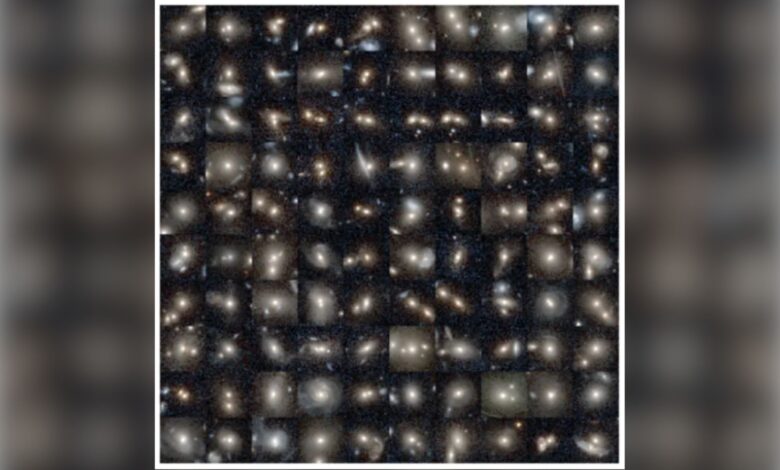
Spectacular galactic collisions are capable of awakening dormant supermassive black holes, triggering powerful energy outbursts at their centers. This conclusion was reached by astronomers after analyzing images of one million galaxies captured by the Euclid space telescope and state-of-the-art artificial intelligence tools. These studies shed light on processes that have long remained a mystery to science.
Active galactic nuclei (AGN) are phases when the black hole at the center of a galaxy begins rapidly devouring surrounding matter. As material falls into the accretion disk, it heats up and emits light, while some particles are expelled into space at nearly the speed of light. These objects are known as quasars, or, in the case of the most powerful eruptions, blazars. Until now, scientists only suspected that galaxy mergers could trigger these phenomena, but lacked direct evidence.
The challenge was that even the most advanced telescopes, such as Hubble and James Webb, could not cover a large enough area of the sky to allow for statistical analysis. Euclid, launched by the European Space Agency in 2023, changed the game with its 1.2-meter mirror system and 600-megapixel camera, enabling detailed images of vast regions of space.
The role of artificial intelligence
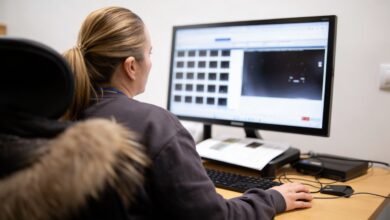
Astronomers divided a million galaxies into two groups: those undergoing mergers and ordinary, non-interacting ones. To analyze them, researchers used a special artificial intelligence algorithm capable of recognizing signs of black hole activity and estimating their strength from images. This approach revealed patterns that had previously gone unnoticed.
The results were striking: in merging galaxies, there were 2 to 6 times more active nuclei than in ordinary ones. The difference is especially pronounced immediately after a merger, when the galaxies are shrouded in dense dust clouds visible only in the infrared spectrum. Here, the number of active nuclei is six times higher than normal. Even at late merger stages, when the galaxies have nearly combined, black hole activity remains twice as high as in isolated systems.
Impact on galaxy evolution
These discoveries confirm that mergers are the main trigger for awakening supermassive black holes. This is especially true for the brightest and most powerful AGN, which require vast amounts of gas and dust funneling into the galaxy’s center. Under normal conditions, such volumes can’t reach the black hole, but during galactic collisions, gravitational forces literally drive the material into the core.
Active galactic nuclei not only absorb matter but also emit enormous amounts of energy, heating the surrounding gas and hindering the formation of new stars. This has a significant impact on the galaxy’s future, slowing down or even completely halting star formation processes. Thus, mergers not only activate black holes but also determine the pace of evolution for the entire galactic system.
Statistics and new horizons
Interestingly, some active nuclei have been found even in galaxies that outwardly appear normal. According to scientists, this is because many of them have already completed the merger process and have taken on their familiar appearance. However, traces of recent black hole activity persist for a long time, making them detectable even millions of years after the event.
The data obtained open up new opportunities for modeling galaxy formation and development processes. Astronomers can now more accurately predict how often these mergers occur and how they affect the structure of the Universe as a whole. In the coming years, even more detailed results are expected to be published, which will help uncover the remaining mysteries of the cosmos.
In case you didn’t know, Euclid is an ambitious mission by the European Space Agency that launched in 2023. The telescope’s main goal is to study dark matter and dark energy by mapping billions of galaxies. Thanks to its unique combination of a wide field of view and high resolution, Euclid has become an indispensable tool for modern astronomers. The project involves leading European research centers as well as artificial intelligence experts, delivering world-class results.