A heated debate is unfolding in Spain over new regulations for train drivers that directly impact the safety of millions of passengers. After the tragic incident in Adamuz, which claimed dozens of lives, the railway company Adif has introduced strict restrictions that have already sparked a wave of criticism from industry professionals. Now, the responsibility for preventing accidents has essentially shifted onto the train drivers themselves, rather than the safety system or infrastructure.
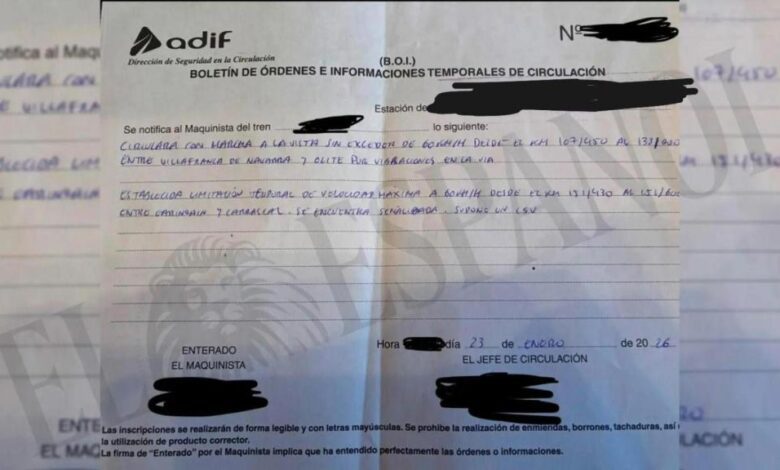
This concerns the so-called ‘restricted visibility running’—a special operating mode in which the driver is required to operate the train at a speed that allows stopping in time for any obstacle on the track. Previously, this protocol was used only in exceptional cases and over short sections, but it is now being applied over dozens of kilometers of railway. For example, in Navarra, drivers are forced to reduce their speed from the usual 140 km/h to 60 km/h for 25 kilometers due to detected vibrations in the rails.
A sharp tightening of rules
Railway industry professionals note that such measures have never been applied over such long stretches before. Normally, ‘restricted visibility running’ was only introduced over 500-meter sections if animals, fallen objects, or rocks were spotted on the tracks. Now, however, drivers are required to use this mode over dozens of kilometers, which raises confusion and safety concerns.
According to current regulations, the train operator is required to exercise maximum caution and adjust the speed so that the train can be stopped at any moment. This means that all responsibility for potential incidents falls on the individual, not on automated systems or the technical condition of the tracks. Within the profession, this practice is seen as an attempt to shift responsibility for infrastructure conditions away from management and onto the employees.
Union response
The situation escalated after the tragedy in Adamuz, when train drivers’ unions called a strike demanding immediate changes to the safety system and improvements to the railway network. Representatives from SEMAF stated that the current measures not only fail to solve the problem, but also create additional risks for passengers and staff. In their view, introducing ‘drive by sight’ on long sections is not a solution, but a temporary measure that could lead to further tragedies.
In August 2025, unions had already appealed to Adif management and the state safety agency, demanding an unscheduled inspection of track conditions in the Adamuz area. The reason was recorded vibrations, which could indicate hidden defects. However, according to workers, the response was not swift enough, and the new rules only worsened the situation.
Pressure on train operators
The introduction of new restrictions is seen by many as an attempt by Adif to ‘wash its hands’ and shift responsibility for the technical condition of the railways. Now, if an accident occurs, it will be the train driver who is held liable—even if the cause lies in worn tracks or faulty equipment. This is causing concern not only among industry workers but also among passengers, who fear for their safety.
Industry professionals point out that this practice is already in place on high-speed rail lines whenever Adif management considers it necessary. However, neither side sees such measures as a long-term solution. Instead of investing in infrastructure upgrades and implementing modern safety systems, responsibility for people’s lives is being placed on the one person inside the locomotive cab.
Consequences for passengers
For passengers, the new rules mean not only slower speeds and longer journeys, but also growing anxiety. Many are questioning how safe it is to travel by train now, especially when engineers’ unions are openly talking about the risks. On social media, people are discussing why, instead of upgrading tracks and equipment, authorities are choosing to tighten staff requirements.
At a time when Spain’s railway network urgently needs investment and modernization, such decisions are raising increasing concerns. Passengers and industry workers expect real action to ensure safety on the country’s railways, not just temporary measures from the management.