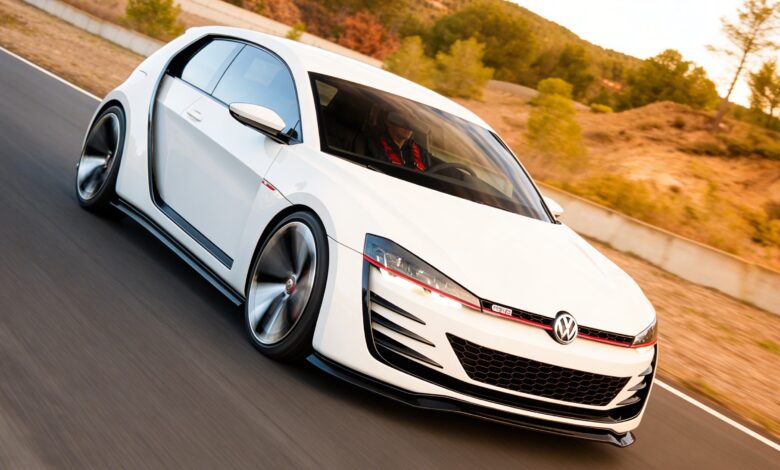
The Volkswagen Golf Design Vision GTI redefined what a compact sports car can achieve. Based on the Golf VII GTI, this concept challenged conventional standards, demonstrating that even a hatchback can rival supercars in performance and technology. Unveiled at Wörthersee in 2013, it made a big impact, and its technical solutions and styling continue to inspire engineers and designers years later.
The exterior of the Golf Design Vision GTI sets it apart from other models at first glance. Widened fenders, a low stance, and massive air intakes give it the look of a true race car. Every body element underscores its aggressive character, while the tension in its lines hints at hidden power. There’s no room for modesty here—this car was built to turn heads and spark emotions.
The technical side of this concept matches its striking looks. Under the hood is a 3.0-liter V6 TSI engine with twin turbochargers, producing 503 hp and 560 Nm of torque. Paired with a six-speed DSG and 4MOTION all-wheel drive, it accelerates from 0 to 100 km/h in just 3.9 seconds and reaches a top speed of 300 km/h. Such numbers are rare for compact cars and remain impressive even today.
Interior and details
The Golf Design Vision GTI’s cabin resembles a race car cockpit. The interior is dominated by carbon fiber and Alcantara, with all elements designed around lightness and functionality. Traditional door handles are replaced with straps, and the center console is minimalist. Sport seats with multi-point harnesses and a hefty rear crossbar highlight the car’s track-oriented focus.
The steering wheel features paddle shifters and a drive mode selector, reinforcing the sensation of piloting a true sports car. Every aspect of the interior is engineered for maximum control and safety at high speeds. There are no excesses here—only what’s truly needed for fast driving and confidence behind the wheel.
Volkswagen didn’t make this concept car all-purpose. Unlike the production GTI range, which balances comfort and dynamics, the Design Vision GTI is all about emotion and driving excitement. Not everyone appreciated this approach, since the traditional Golf GTI has always been known for its practicality. However, it was the radical design of this concept that earned it cult status among brand enthusiasts.
Industry impact
The arrival of the Golf Design Vision GTI was a milestone for the entire hot hatch industry. This car proved that boundaries can be pushed without sacrificing brand identity. Years after its debut, many modern models still draw inspiration from solutions first introduced in this concept.
In 2013, Volkswagen used this project to strengthen the GTI image at the Wörthersee festival, where fans gathered to see the most striking and unusual versions of their favorite models. At that time, GTI was not just an abbreviation but a symbol of an entire era and lifestyle. Today, it’s difficult to recreate the same emotions, but the Golf Design Vision GTI remains a benchmark among concept cars.
Not all prototypes stand the test of time, but this car continues to attract interest from collectors and experts. Its design and technical solutions have not become outdated—in fact, they have become a reference point for new developments. According to RUSSPAIN.COM, projects like this shape the future of sports cars, setting new standards for the entire segment.
Comparison with competitors
Compared to other models, the Golf Design Vision GTI truly stands out. While production versions aim for versatility, this concept shows what a hatchback can do without compromise. Whether this approach is justified remains a topic of debate among car enthusiasts. Some believe such projects exist only for show, while others see them as sources of innovation for future generations.
Interestingly, comparisons with other popular models, such as the Opel Astra, often reveal unexpected differences not only in power but also in the overall approach to designing a vehicle. For example, in coverage comparing these two models, you can find details that challenge conventional ideas about practicality and technology: an analysis of the nuances between Opel Astra and Volkswagen Golf shows that even small details can influence the decision.
The Golf Design Vision GTI became an example of how a concept car can go beyond the usual showpiece and become a true symbol of engineering innovation. Its appearance changed perceptions of compact sports cars and proved that real breakthroughs are possible even in this segment.
The Volkswagen Golf Design Vision GTI is not just an experimental car but a milestone in the brand’s history. It was created to showcase the full potential of the Golf platform and became one of the most talked-about concepts of its time. Thanks to its unique combination of power, design, and technology, this car continues to inspire engineers and fans of fast hatchbacks around the world. Its legacy can be felt in every new Volkswagen sports model, while the concept itself holds an honored place in automotive history.