Digital creativity in 2025 goes beyond traditional editing. The focus now is not only on modifying existing images, but also on creating new ideas from scratch. Modern tools make it possible to combine various formats, build complex visual concepts, and work with them in a highly flexible way. In this new environment, Photoshop is gradually transforming into the core of an entire ecosystem, where artificial intelligence and assisted generation are taking on an increasingly prominent role.
Integration of New AI Models in Photoshop
Adobe has expanded the Generative Fill feature in Photoshop Beta by adding new solutions to the existing Firefly models: Gemini 2.5 Flash Image and FLUX.1 Kontext [pro]. The first is optimized for quickly generating detailed images; the second is designed for creating expressive and stylized visual effects. Each tool serves different tasks—from photorealistic results to experiments with abstraction and style.
All new models are fully integrated into the familiar Photoshop workflow. Users can independently choose which engine to use for a particular task, allowing for more precise control over the final image. This applies to working with masks, selections, layers, and correction tools. Artificial intelligence is no longer just an external option, but becomes part of the standard toolkit, making the transition between generation and manual editing virtually seamless.
Firefly Boards: Collaborative Generation and New Formats
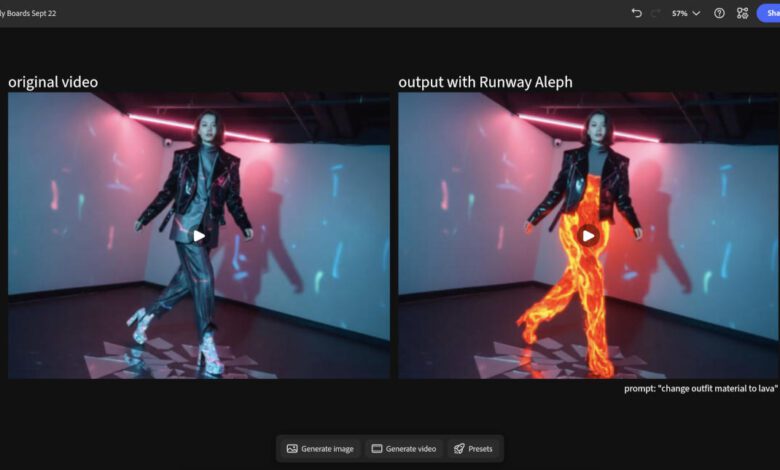
At the same time, Adobe introduced Firefly Boards—a platform for collaborative idea development. Here, the focus shifts from individual editing to teamwork, discussing concepts, and creating resources across various media. Firefly Boards integrates video generators like Runway Aleph and Moonvalley Marey, along with new tools: quick presets, image-based description generation, and contextual text rewriting. This is an evolution of classic moodboards, now enhanced with real-time AI capabilities.
The connection between Photoshop and Firefly Boards
Adobe aims to make Photoshop and Firefly Boards complementary parts of a unified system. Firefly Boards serves as a space for brainstorming and experimentation, while Photoshop enables precise execution. The ability to freely transfer elements, styles, and palettes between the two platforms ensures a seamless workflow from planning to final editing. This approach allows creators to work without technical constraints at every stage.
Limitations and challenges for users
However, not all new features are available to the general public. Many functions are currently only implemented in test versions and require an active Creative Cloud subscription. Access to the most advanced models or working with images at maximum resolution may require additional credits or compliance with specific conditions. Moreover, AI integration raises questions about maintaining creative control and the potential dependence on technology in developing original ideas.
Photoshop’s new role in digital production
Today, Photoshop is evolving beyond a mere image editor. Adobe now presents it as a central hub for an entire ecosystem, combining assisted creativity, collaborative work, and content generation across various formats. The focus is no longer just on expanding features, but on rethinking the software’s role in the complete visual project workflow. The key question is not what can be done in Photoshop, but how it can organize the entire image creation process.