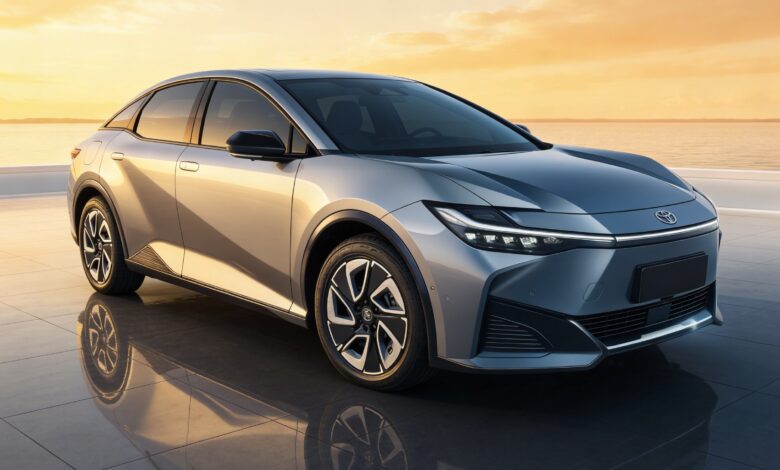
The electric car market is experiencing a moment when familiar price benchmarks are collapsing. The Toyota bZ3, available exclusively in China, has become a real challenge for European car enthusiasts: after recent discounts, its price has dropped below €12,000. This isn’t just a number—it’s a signal that an affordable electric car already exists, but remains out of reach for Europeans. The price gap between China and Europe is explained not only by differences in salaries or taxes, but also by specifics of production, local partnerships, and state support.
In China, the Toyota bZ3 is sold starting at 93,800 yuan, which is about €11,800 at the current exchange rate. For comparison, in Spain the most affordable electric Toyota—the C-HR+—costs €35,375, while the flagship bZ4X starts at €39,375. Even the Dacia Spring, considered the benchmark budget EV in Europe, is offered at a minimum of €16,425. If the bZ3 appeared on the European market, it would be unrivaled in affordability, even without government subsidies.
The Chinese approach
The secret to Toyota bZ3’s low price lies in how it is made. The model was developed in partnership with China’s BYD and is manufactured at FAW Toyota’s facilities. This alliance makes it possible to use local components, reduce logistics costs, and implement advanced technologies such as BYD’s Blade batteries. These batteries are considered among the most reliable and inexpensive on the market, further lowering the car’s final price.
Unlike typical budget models, the bZ3 is not a small city car but a full-fledged mid-size, or even large, four-door vehicle nearly 4.73 meters long. Inside, it features a contemporary cabin with a large 15.6-inch central display, a digital instrument cluster, and an extensive suite of electronic driver aids. Even the base model comes with options that in Europe are only available in high-end versions: a panoramic roof, wireless phone charging, and LiDAR sensors.
Technical details
Technically, the Toyota bZ3 is offered in two versions: the base model comes with a 49.9 kWh battery and a claimed range of 517 km according to the Chinese CLTC cycle, while the top version has a 65.3 kWh battery and can go up to 616 km. The motor produces 184 or 245 hp, respectively. The Chinese range standard differs from the European WLTP, but even with that adjustment, these figures are impressive for the price.
The bZ3 lineup offers several trim levels: the base version costs 93,800 yuan (11,800 euros), the Pro — 129,800 yuan (16,375 euros), the Pro+ — 139,800 yuan (17,637 euros), and the Max — 159,800 yuan (20,160 euros). Even the top configuration is half the price of European equivalents. This pricing strategy has been made possible by intense competition in the Chinese market and strong government support for manufacturers.
A European contrast
While European buyers are forced to choose between expensive electric cars and compromises in equipment, the Chinese market shows that it’s possible to get a modern car with decent range and a rich set of features for a price that seems fantastic in Europe. According to RUSSPAIN.COM, this price difference is driven not only by economic factors, but also by policies supporting local manufacturers, as well as taxation and certification specifics.
However, the availability of electric vehicles in Europe highlights other market paradoxes. For example, as recently discussed in an article about unexpected decisions by automakers, the strategies of major companies often surprise consumers and lead to unexpected consequences for the market.
In China, the low cost of the bZ3 was made possible by a combination of cheap labor, large-scale production, and generous government subsidies. European car enthusiasts can only watch this phenomenon from the sidelines, as even the most basic city electric cars here are noticeably more expensive.
The Toyota bZ3 is the result of a collaboration between the Japanese automotive giant and Chinese companies BYD and FAW Toyota. The model is aimed at the Chinese domestic market, where competition among electric vehicles is especially intense. Thanks to advanced technologies and localized production, the bZ3 has become one of the most affordable electric cars in the world. Despite its limited sales geography, this vehicle has already influenced perceptions of electric cars as mass transport and set a new standard for manufacturers worldwide.