The vast plains of La Mancha, dotted with windmills and vineyards, hold more than just the legacy of Don Quixote. Amid these sun-scorched landscapes, where the horizon seems endless, dozens of tiny settlements have preserved the authentic spirit of rural Spain. One of these places stands out even among the rest, offering a true modern paradox: the smallest village in the province of Ciudad Real, where a handful of residents share the area with an entire international airport.
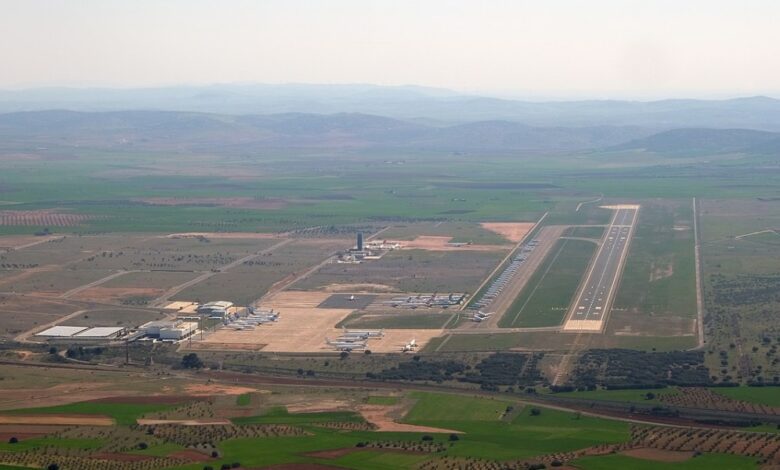
This place is called Villar del Pozo. According to the latest census at the start of 2025, only 47 people reside here permanently. That makes it the least populated municipality in the entire province. But its main feature lies not in demography, but in geography. Just 500 meters from the last houses, the vast territory of the Ciudad Real Airport begins.
A paradox in the heart of Spain
Picture this: a quiet village street where the only sounds are birds singing and olive trees rustling, with a runway in the background large enough for the world’s biggest airliners. The contrast is striking. A grand, sprawling airport stands there, but today it handles no regular commercial flights, making its proximity even more surreal. For the residents of Villar del Pozo, the enormous terminal and deserted runway have become a fixture of the landscape—a silent reminder of once-ambitious plans and shifting economic fortunes.
Despite its unusual neighbor, the village maintains its own pace. There’s none of the hustle and bustle you’d expect around a transport hub. On the contrary, Villar del Pozo is an oasis of calm. Life moves slowly and steadily, perfectly in tune with the rhythms of nature and the agricultural calendar that has shaped everyday life in this part of Spain for centuries.
Living by the rhythm of the siesta
Choosing a life in Villar del Pozo is a conscious step toward peace and simplicity. Locals value the open spaces, the lack of noise, and the chance to live far from urban chaos. Of course, this idyll has its drawbacks: the village itself has no shops, schools, or medical centers. Residents travel to neighboring, larger towns for essentials—a minor inconvenience, since they’re just a short drive away.
This minor inconvenience is more than offset by other advantages. The main one is housing affordability. Rental and property purchase prices here are incomparably lower than in major cities, attracting those seeking solitude or simply looking to save money. Life in Villar del Pozo revolves around a close-knit community where everyone knows each other and social ties matter. It’s a world far removed from the anonymity of big cities.
An airport that doesn’t fly
Although Ciudad Real airport doesn’t welcome crowds of tourists, it can’t be called completely abandoned. Today, it operates as a private facility for aircraft maintenance and long-term storage. Airlines from around the world use its runway and hangars to park their planes when demand is low. In addition, training flights are held here, and private business jets are serviced.
Thus, the “ghost airport” still generates some economic activity and even provides jobs for a few locals from nearby villages. For Villar del Pozo residents, this means that their unusual neighbor is not just a silent monument to ambition, but an operational—albeit in a special mode—facility. And while the roar of turbines is rare, the sight of massive airplanes resting under the La Mancha sun remains the calling card of the province’s smallest village.
Incidentally, Central Ciudad Real Airport (Aeropuerto Central Ciudad Real) was the first private international airport in Spain. Its construction cost over 1 billion euros, and it was inaugurated in 2008, on the eve of the global financial crisis. Originally, the project was conceived as an alternative to Madrid’s Barajas Airport and was expected to handle up to 2.5 million passengers a year. However, due to low traffic and massive debts, it went bankrupt and was closed in 2012. After several years of inactivity and failed auctions, it was acquired by a private company in 2019 and reopened with a new focus on cargo services, aircraft maintenance, and aviation parking.