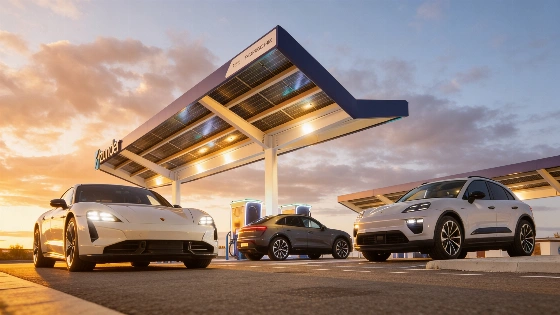
Spain Allocates 100 Million for Fast Chargers: 'Dark Zones' for EVs Will Disappear. Spanish authorities are launching a large-scale program to install 337 fast charging stations for electric vehicles. This initiative aims to eliminate 'dark zones' on the roads and make long-distance travel in electric vehicles safer and more convenient.
100 million euros — this is the amount Spain is allocating to address one of the main obstacles to the development of electromobility: the lack of fast charging stations on intercity highways. The new IDAE program provides for the installation of 337 high-power charging points, which are intended to eliminate so-called "dark zones" — stretches of road where it was previously impossible to recharge.
According to AEDIVE Association, as of May 2026 there are 54,794 operating charging points in the country. However, this number is insufficient: many of them are unevenly distributed, and some do not work due to technical problems or lack of grid connection. By the end of 2025, according to ANFAC, the number of out-of-service chargers reached 16,340 — nearly a quarter of all installed devices.
The problem is especially acute on long routes between regions. Electric vehicle drivers risk running out of charge for dozens of kilometers if there are no fast stations along the way. These very "dark zones" are what the new IDAE initiative aims to eliminate, funded under the Moves program to develop charging corridors.
Who will receive funding
Most of the new stations will support a power output of 150 kW, enabling fast charging for modern electric vehicles and making long-distance travel a reality. Among the largest recipients of government support is Wenea, which has been allocated almost 14.8 million euros for 25 projects. Zunder will receive 13 million euros to launch 54 new locations. Part of the funding will go toward upgrading existing stations, such as those in Madrid (Ensanche de Vallecas), highway locations in Valencia, Alicante and Cantabria, as well as the construction of new facilities in Barcelona, Albacete, and Ourense.
The third largest recipient of funding is the Iberdrola BP Pulse alliance—12.2 million euros for 41 new charging hubs in cities such as Malaga, Cáceres, Seville, Toledo, León, Jaén, Huesca, Ávila, Albacete, and Badajoz. Among the projects with the highest rating (95 points) are three Endesa stations in Lleida, Soria, and Huesca, each set to receive four charging points with support of 72,000 euros.
Other notable recipients include EV Charger Ingeniería (Puebla de Sanabria, Zamora), Grupo Easycharger (Calahorra, La Rioja), and Repsol (Ourense). In Soria, Endesa will build 18 charging points for a total of 49,000 euros, while in Trujillo (Cáceres), Iberdrola | bp pulse is carrying out a project worth over 300,000 euros. Zunder will also expand its network in Albacete and Cáceres.
Major projects and geography
The most expensive project is a charging hub in Villena, which will receive more than 4 million euros. Major investments also include a Wenea station in Malpartida de Plasencia (1.5 million euros) and another facility from the company in Ciudad Real (more than 1 million euros).
The expansion of infrastructure should not only improve convenience for electric vehicle owners but also accelerate the shift to environmentally friendly transport. Experts note that the availability of fast charging is becoming a key factor for the mass adoption of electric vehicles. Importantly, new stations will appear not only in major cities but also at strategic locations between regions, where charging was previously impossible.
The development of charging infrastructure in Spain has been discussed repeatedly. For example, recent legislative changes have made it easier to install charging stations in residential complexes — more details can be found in the article about the Supreme Court's decision: new rules for charging electric cars in garages.
According to industry estimates, the launch of new stations should significantly reduce drivers' anxiety and make electric vehicles more attractive to a broader audience. If the program is implemented on time, Spain will be able to approach European standards in terms of charging network density and availability.