Italy Builds Giant Sea Barrier to Restore Genoa as the Mediterranean’s Main Port. Genoa is constructing a unique sea barrier from 70 giant concrete blocks to accommodate the world’s largest container ships. The project aims to shift the balance of power among Mediterranean ports and strengthen Italy’s position in international trade.
One of the largest port construction projects in Europe has begun in Genoa: a new maritime barrier over six kilometers long is being built here to allow the Italian port to accommodate giant container ships up to 400 meters in length. This project is an attempt to restore Genoa's leadership in a region now dominated by Barcelona, Valencia, and Algeciras.
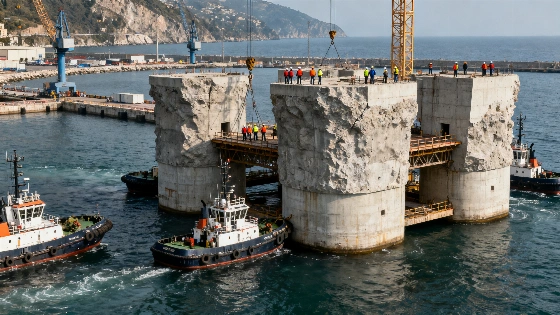
The work is being carried out in open sea, about half a kilometer from the shore. The main feature is the use of 70 enormous concrete megablocks, each the size of a ten-story building: up to 67 meters long, more than 30 meters wide, and about 33 meters high. These structures are assembled on land, then towed and lowered to the seabed at depths of up to 50 meters. After installation, the inner cavities of the blocks are filled with stone to ensure stability against storms and currents.
Why does Genoa need a megabarrier?
Italy expects the new barrier will allow the port to receive not only the largest container ships but also modern cruise liners. For this, deep and wide channels are required, which the old port could not provide. According to Talent24h, Genoa currently ranks sixth among Mediterranean ports in terms of maritime trade volume but expects to rise higher thanks to these new opportunities.
The project is being carried out by the PerGenova Breakwater consortium led by Webuild, commissioned by the Western Ligurian Sea Port Authority. More than 60 vessels are involved in the construction: some deliver materials, others are responsible for the precise placement of the blocks on the seabed. By the end of April 2026, 20 mega blocks have already been installed and over 880 meters of the barrier have been built—about one seventh of the entire structure.
Technology and challenges
Building at such depth and distance from shore requires constant coordination between marine and underwater teams. Each block must be placed with centimeter-level precision, or the entire barrier line could shift. Advanced navigation systems and underwater drones are used for control. Similar technologies have already been applied in other major infrastructure projects, for example, in the construction of houses without cement using robots—as described in the article about the construction robot Charlotte.
A bet on the future
Genoa is betting on the growth of cargo traffic between Asia, Europe, and America. The new barrier should not only protect the port from storms but also make it more attractive to the largest shipping companies. As competition among Mediterranean ports intensifies, Italy aims to win back some of the cargo traffic that currently goes through Spain.
Experts note that the project's success depends not only on engineering solutions, but also on how quickly the port can adapt its internal infrastructure to new standards. If Genoa manages to implement its plans, the balance of power in the region's maritime trade could change significantly.