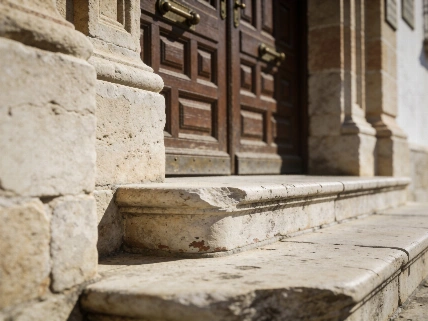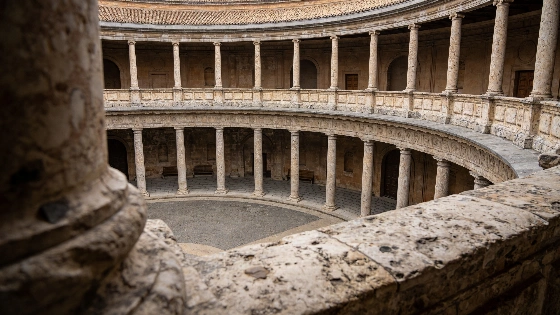
When restoration began in 1923, the palace’s roof had collapsed and its stones had spent centuries exposed to the weather. Leopoldo Torres Balbás led the first stage. Francisco Prieto Moreno followed, assigning the building to museum and institutional use in 1958.
The palace still divides opinion over its place within the Alhambra. Some see it as an intrusion into a site shaped by its Islamic past; its defenders argue that it is an accomplished example of Renaissance architecture. The disagreement reflects the contrast between the palace’s Renaissance design and the Nasrid buildings around it, along with the symbolism of establishing a Christian imperial residence within the former Muslim royal precinct. Torres Balbás acknowledged that the building changed the appearance of the grounds compared with their Muslim-era form, while maintaining that the Christian palace and the former royal residence could coexist without merging. RUSSPAIN.COM has also covered Spain’s historical record in its report on Hornachos cemetery.
The building’s story began after Carlos V arrived in Granada in 1526 following his marriage to Isabel of Portugal. The couple spent their honeymoon at the Alhambra. Impressed by the complex, the emperor decided to build a Christian imperial residence at the former seat of the Nasrid sultans. They stayed in Granada for six months, but he soon lost interest in the project.
Accounts differ over Isabel’s departure from the Alhambra. One explanation attributes it to the cold in its palaces. Another says she feared earthquakes. A separate account links her move to a pregnancy and a preference for the quieter Monasterio de San Jerónimo over the court established by the emperor at the Alhambra.
One political explanation presents the palace as a statement of Christian rule and imperial power, connecting the new monarchy with the former Arab royal seat. Carlos V entrusted the design to Pedro Machuca, whose architectural language reflected the Italian Renaissance rather than the Nasrid tradition. Work started in 1527 on a square block with a circular courtyard and 32 columns made from conglomerate stone from Loja. The contrast between the square exterior and circular courtyard gives the palace its distinctive geometric design.
The emperor obtained initial contributions from the Moriscos, imposed a tax on those who kept their customs and required annual payments towards construction, according to Manuel Gómez Moreno’s guide. The project stalled soon after Carlos V and Isabel left Granada. Historian Lafuente Alcántara wrote that the emperor became occupied with other events and forgot the work.
Pedro Machuca and later his son Luis spent nearly 40 years on the project. Other architects followed, but construction stopped completely in 1623. Later kings tried to restart it without finishing the palace. Its roof deteriorated, and its masonry remained exposed.
By the 19th century, many visitors to the Alhambra passed the building without stopping. The French writer Gautier considered it out of place, while Wolzogen criticised the decision to put a new seat of power beside the Alhambra’s eastern architecture. Prieto Moreno’s 1958 plan gave the palace a defined institutional role: it became home to the Museo de Bellas Artes and the Museo de la Alhambra.