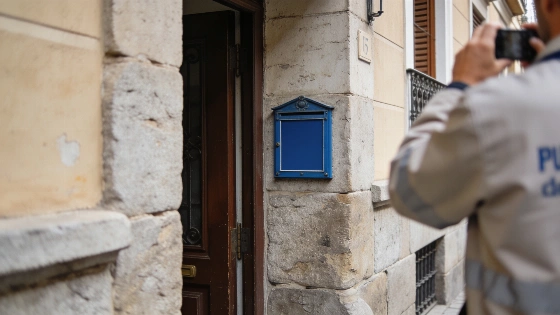
A blue plaque now marks the Madrid home where Maricarmen was evicted. Its message names Urbagestión's owners and cites Spain's constitutional right to housing.
On 23 September 2026, 87-year-old Maricarmen was evicted from the Retiro flat where she had lived since 1955. Two days later, a blue plaque appeared at number 46 on Calle Sainz de Baranda.
The plaque gives the eviction date. It names Ricardo Alonso Fernández and Fernando Alonso Fuentes as responsible for the decision, according to the wording on the plaque. It also names Article 47 of the Constitución Española and identifies the building as part of the dispute involving Urbagestión.
The marker appeared on Monday, mounted at mid-height on the right side of the entrance. Independent reports identify the property owner as Urbagestión Desarrollo e Inversión SL.
BBC Mundo reported that the rent had been raised from approximately €500 to €2,650 after the property was acquired in 2018.
Its design is easy to recognise. The blue format closely resembles plaques used by the Ayuntamiento de Madrid to honour people and businesses or to mark places tied to historical events.
That changed the building's appearance.
A private entrance now carries an official-looking public message. The plaque does not come from the city, but it borrows the city's visual language.
Félix Sánchez, a Bluesky user, reported the plaque and photographed it because he feared municipal agents might remove it. Agents were seen taking pictures during the morning.
The available material does not show whether anyone ordered a removal. It also does not establish who carried out the intervention.
Two days after the eviction, Urbagestión offered to transfer the flat to Madrid’s city government so that Maricarmen could return under an affordable-rent arrangement through the Reviva programme. The city rejected the proposal, saying it did not meet the legal requirements, and offered mediation instead.
No person or organisation has claimed authorship. The plaque's origin remains unknown, even though its wording openly assigns responsibility for the eviction.
Article 47 of the Constitución Española establishes the right to decent housing. The plaque uses that legal reference on a residential doorway, connecting Maricarmen's case with a principle normally discussed in legal and political settings.
Reuters, BBC and Euronews reported that the eviction took place on 23 September 2026. Maricarmen had lived in the Retiro flat for roughly 70 years. Euronews described the action as the fourth attempt to carry it out.
Reuters also cited Maricarmen's lawyer, who said the company and court officials refused to suspend the procedure despite humanitarian appeals and documents about the search for alternative accommodation.
Protesters gathered outside the building. Clashes with police followed. A BBC video report mentioned the use of tear gas against demonstrators.
The confrontation pushed the case beyond the eviction itself. Reuters and BBC placed it within Spain's housing crisis, marked by rising rents, a shortage of affordable homes and pressure on older tenants with fixed incomes.
RTVE reported that Urbagestión rejected the description of the company as a "fondo buitre". The broadcaster also recalled that the former owners sold the building at 46 Calle Alcalde Sainz de Baranda to a major Spanish development group in 2018.
The dispute then moved through the courts and reached Spain's Supreme Court.
An earlier report described the owners' position and the dispute over the home. That account makes the new plaque another visible stage in a conflict that has already drawn attention beyond the building itself.
The earlier report also recorded the campaign around Maricarmen's home.
The facts that can be established are narrow. Maricarmen lived in the same house from 1955 until her eviction. A plaque appeared at the entrance. Municipal agents photographed it. Its author is not known.
The city has not officially recognised the marker on the evidence available. Someone used the city's plaque style to turn a doorway into a record of the dispute. The result is hard to miss.