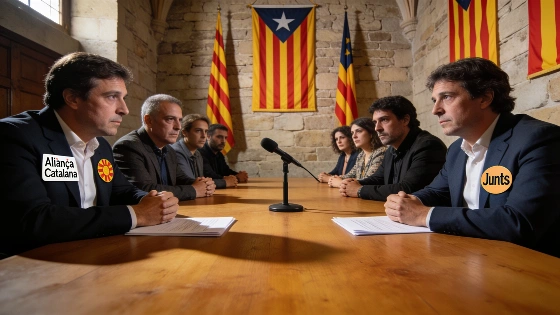
Aliança Catalana is intensifying efforts to recruit Junts councillors. The party has already attracted several local politicians, raising pressure on Junts. The trend signals a changing political landscape in Catalonia.
Aliança Catalana has stepped up its campaign to attract not just voters but also elected officials from Junts, marking a new phase in Catalonia's political rivalry. In recent months, the far-right pro-independence party has managed to bring several Junts councillors and former Convergència affiliates into its ranks, a move that is reshaping local politics ahead of the 2027 municipal elections.
The most notable defection occurred this week in Cambrils, Tarragona, where Enric Daza, a prominent Junts councillor and spokesperson, announced he would run for mayor under the Aliança Catalana banner. Daza, a businessman with a long record in local politics, cited months of discussions and a growing alignment with Aliança's leadership as reasons for his switch. His decision follows a period of internal negotiations and reflects a broader trend of local politicians seeking new platforms as party dynamics shift.
Aliança Catalana's strategy involves both active recruitment and responding to interest from disillusioned Junts members. According to party officials, the focus is on candidates with political experience and ideological proximity, rather than those seeking a career in politics. The party's secretary of organization, Oriol Gès, confirmed that similar talks are ongoing in other municipalities and expects the movement of councillors to intensify as the next elections approach. This approach has already increased Aliança's representation in local councils from eight to fourteen seats since the 2023 municipal elections, without additional votes being cast.
Junts, meanwhile, faces mounting pressure as polls suggest it is losing ground to Aliança Catalana. The latest survey by the Centre d'Estudis d'Opinió places Aliança in third place for a hypothetical regional election, potentially overtaking Junts. Party leaders have questioned the reliability of these polls, but the steady flow of councillors leaving for Aliança has forced Junts to reconsider its strategy. The initial tactic of ignoring Aliança as a fringe phenomenon is no longer effective, and internal debates continue over how to respond to the party's rise.
Other municipalities have seen similar defections. In Roda de Ter, Marina Quintana left Junts to join Aliança, while in Amposta, Eric Esteban, formerly Junts' number two, also switched allegiance, citing greater freedom and alignment with Aliança's leadership. These moves highlight the appeal of Aliança as an emerging force, offering local politicians a chance to be part of a rapidly growing movement. Political analysts point to several factors behind this trend, including the party's electoral momentum, the charisma of its leader Sílvia Orriols, and the active recruitment efforts led by figures like Oriol Gès.
However, the influx of candidates from other parties is not without risks. Experts warn that bringing in outsiders could lead to internal tensions or the inclusion of controversial figures, potentially unsettling Aliança's existing base. The party claims to carefully vet new recruits to avoid opportunism and maintain its ideological coherence.
Aliança Catalana's rise reflects broader shifts in Catalan politics, where traditional party loyalties are being tested by new movements and changing voter expectations. The party's ability to attract experienced local politicians without direct electoral victories signals a transformation in how political influence is built at the municipal level. As the 2027 elections draw closer, the competition for both voters and candidates is expected to intensify, with implications for the balance of power across Catalonia.
For context, Catalonia's political landscape has long been shaped by debates over independence and identity, with parties like Junts and the now-defunct Convergència dominating local and regional politics for years. The emergence of Aliança Catalana, with its hardline stance and active recruitment strategy, introduces new dynamics that could alter traditional alliances and voter behavior. The outcome of these shifts will likely influence not only local governance but also the broader trajectory of Catalan politics in the coming years.