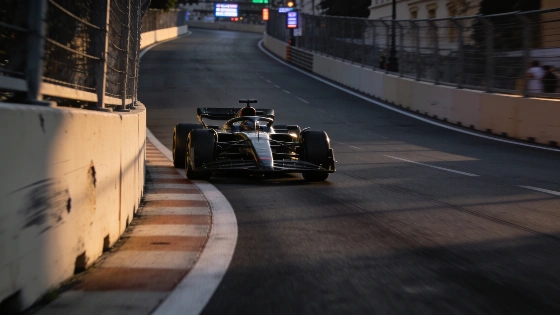
Fernando Alonso says modern Formula 1 rewards drivers for slowing down. He wants less battery power and more time to use it. Aston Martin also expects another difficult weekend in Baku.
Fernando Alonso says Formula 1 has reached a point where drivers must slow down to become faster. The Aston Martin driver believes the current rules have damaged the character of famous circuits. He wants less electrical power from the battery so the cars can be driven more naturally.
His criticism goes beyond performance. The current cars force drivers to calculate their energy use before almost every corner. Regulations, engineering and simulations shape those decisions. That leaves less room for instinct, risk and the slow process of learning a car's limits from one lap to the next.
В силовой установке F1 2026 мощность MGU-K увеличена до 350 кВт, MGU-H убран, а максимальная отдача энергии за круг ограничена 8,5 МДж.
The strongest part of his argument is about the tracks themselves.
Alonso singled out Silverstone, saying it is no longer as enjoyable as it once was. He described the passage through Eau Rouge at Spa as almost embarrassing. He made the same point about the 130R at Suzuka. In his view, this year's rules have taken away some of the challenge from the corners that define the sport.
His fix is specific. Reduce the battery's maximum output and let drivers use that energy over a longer period. The hybrid system would remain, but the balance between electrical deployment and conventional driving would change. Alonso raised the idea during Media Day for the Azerbaijan Grand Prix, in comments reported by Motorsport.com.
Гран-при Азербайджана в 2026 году проходит по изменённому расписанию: media day состоялся в среду, практика запланирована на четверг, квалификация — на пятницу, а гонка — на субботу. Перенос связан с просьбой местных властей.
The argument also helps explain why Alonso has not confirmed his plans for 2027. He has already said at Madring that his decision will depend heavily on how the rules are updated for next season. The amount of electrical power in the cars is not a minor technical detail for him. It is tied to whether Formula 1 still offers the kind of driving challenge he values. PlanetF1 reported that FIA president Mohammed Ben Sulayem has previously discussed Alonso's concerns and the direction of the rules with him.
Aston Martin's immediate prospects offer little comfort. The team has brought a major update to the AMR26 and reduced its weight. Alonso still expects Baku to be another difficult weekend because of Aston Martin's large power deficit and Honda's disappointing engine. He said scoring points and getting beyond Q1 could be difficult.
Baku brings a separate safety concern. On the long straight, cars can reportedly travel at around 200 km/h before the battery is deployed and then reach 350 km/h. Alonso warned that this speed difference must be managed safely, especially when some cars remain slow until their electrical power arrives.
There is still no new information about his future. Alonso says he remains in regular discussions with Domenicali, the F1 chief executive, and Mohammed Ben Sulayem, the head of the FIA, about improving the championship. He has also made clear that he will continue with Aston Martin if he stays in Formula 1. He is keeping open the possibility of racing in other categories.
Alonso's position is unusually direct because it links the technical rules to the value of the racing itself. His complaint is not only that Aston Martin lacks power in Baku. He says energy management has changed the way drivers approach the sport's hardest corners. Motorsport.com describes the wider problem as a move toward battery management instead of flat-out racing. Autosport reports that possible changes could shift the power balance toward a 58 to 42 split in favour of the internal-combustion engine in 2027 and 60 to 40 in 2028.
Until the rules produce cars that reward later braking, earlier acceleration and controlled risk again, Alonso's description will remain hard to ignore. Formula 1, he says, is asking drivers to go slowly so they can go fast.
The FIA has already published the 2026 Formula 1 regulations. The changes to the technical framework are therefore not just a proposal. At the F1 Commission meeting on 21 September 2026, officials agreed only minor changes to the 2026 sporting and financial regulations. The debate about the balance between electrical deployment and engine power is now focused on possible updates for the following seasons.